Portable Generator House in Dublin: Safe and Legal Connection Guide
Connecting a portable generator house in Dublin setup safely requires either an interlock kit, a manual transfer switch, or an outlet inlet box, never extension cords run through windows or doors. Never run a portable generator indoors, in a garage, or in any enclosed space, since this creates a genuine carbon monoxide poisoning risk. A safe, legal portable generator connection typically costs 400 to 700 euro installed by a Safe Electric registered electrician.
Below is exactly why the common shortcuts people describe on Irish forums are dangerous, what the legal options actually are, and what a compliant portable generator house in Dublin connection involves.
Why You Cannot Run Extension Cords Through Windows or Doors
This is the most common mistake homeowners make with a portable generator house in Dublin setup, and it is also the most dangerous.
Running a heavy duty extension cord from an outdoor generator through a window or door gap into your home creates two separate hazards at once. Fire risk builds where the cord is pinched or crushed by the window or door frame, damaging the insulation over repeated use and creating a point where heat can build up under load. Carbon monoxide risk builds simultaneously, since the gap needed to run the cable also allows engine exhaust fumes to drift back into the house, particularly if wind direction shifts during the outage.
Irish forum discussions describe exactly this improvised setup during past outages, cables run under a slightly open window with the generator positioned nearby outdoors. It works in the sense that power flows, but it is not a safe or legal way to connect a portable generator house in Dublin, and it should not be treated as a genuine long term solution.
The Backfeed Danger With Portable Generators
Backfeed happens when a generator is connected directly into a home’s wiring, commonly by plugging it into a socket via a suicide cord, without any isolation device between the generator and the ESB Networks supply.
This is dangerous for two distinct reasons. It can energise the ESB Networks lines outside your property, putting utility workers at risk of electrocution if they are working on what they believe is a de-energised line during a wider outage. It also creates a serious risk inside your own home, since your generator output is not synchronised with the grid, and reconnection when ESB power is restored can damage your generator, your home’s wiring, or both.
Any legal portable generator house in Dublin connection must include a device that physically prevents this scenario, which is exactly what the options below are designed to do.
Legal Connection Options for a Portable Generator
Interlock Kit
An interlock kit is a mechanical device fitted at your consumer unit that physically prevents the main utility supply MCB and a dedicated generator supply MCB from being switched on at the same time. Picture a metal sliding plate mounted across both breakers, one that only allows one of the two to move into the on position at once.
This is the most cost effective legal option for a portable generator house in Dublin connection, since it does not require a separate transfer switch panel, just the interlock hardware and a dedicated circuit fitted by a registered electrician.
Manual Transfer Switch
A manual transfer switch is a small additional panel installed near your consumer unit, wired to a selected number of circuits you want to power during an outage, lighting, fridge, boiler controls, for example. You physically flip the switch to move those circuits from the utility supply to the generator supply, with no possibility of both being connected simultaneously.
This option costs slightly more than an interlock kit but gives clearer, dedicated control over exactly which circuits draw generator power.
Outlet Inlet Box
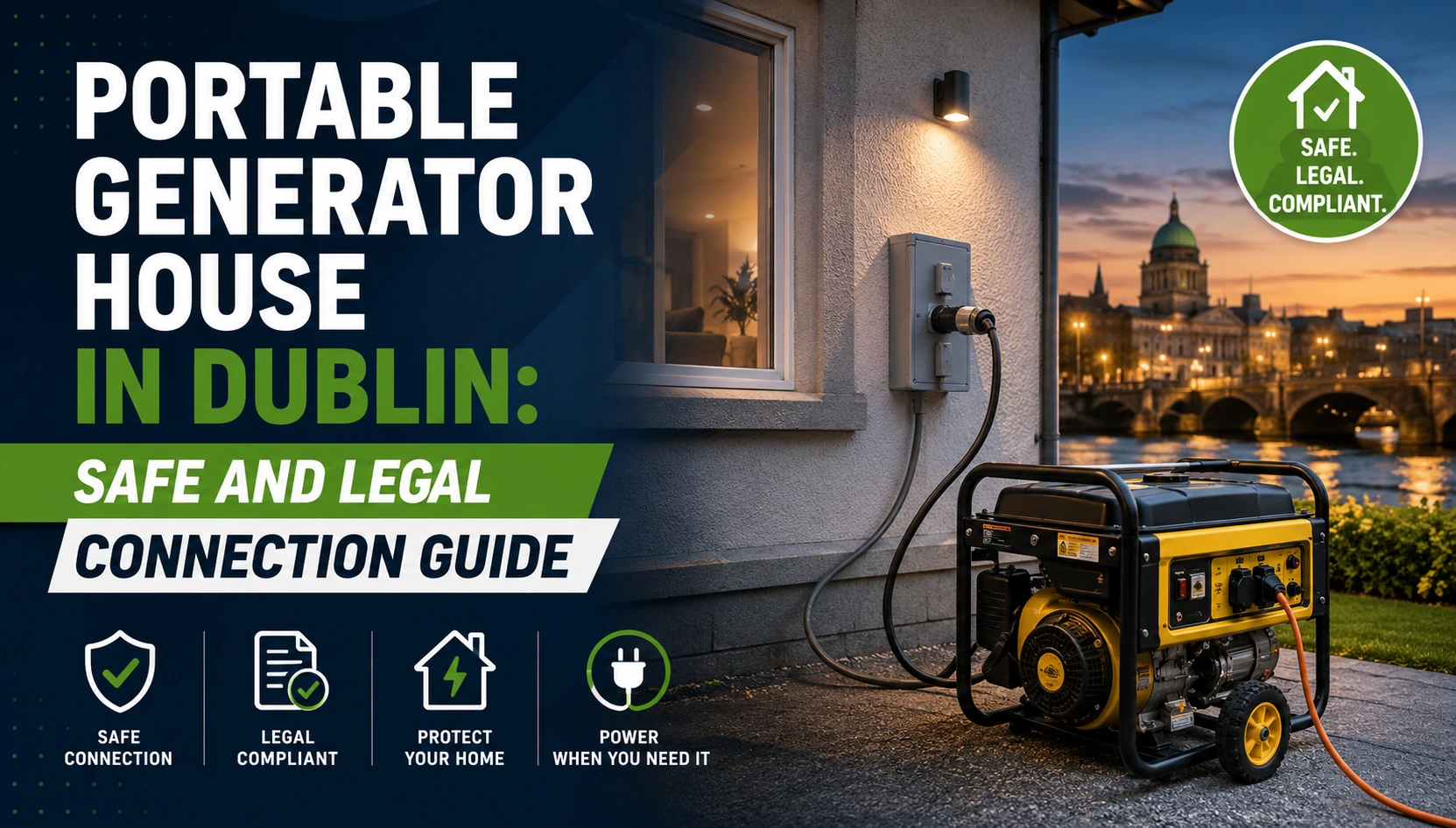
A weatherproof inlet box, fitted to the exterior wall of your property, gives your portable generator a proper, sealed connection point rather than a cable run through a window. The generator connects to the inlet box via a purpose built cable, and the inlet box wiring runs to either an interlock kit or transfer switch inside, completing a safe, legal path into the home.
This is the piece that eliminates the window or door cable problem entirely, and it is a standard part of any properly installed portable generator house in Dublin setup.
Carbon Monoxide Risk: Never Run a Generator Indoors
This point cannot be overstated. Never run a portable generator indoors, in a garage, in a shed, or in any enclosed or partially enclosed space, even with doors and windows open.
Portable generator engines produce carbon monoxide, a colourless, odourless gas that builds to dangerous concentrations extremely quickly in any enclosed space. Fatalities from generator related carbon monoxide poisoning follow this exact pattern almost every time, a generator run in a garage or porch for shelter from weather, with the assumption that some ventilation is enough. It is not.
Key safety points for outdoor placement:
- Position the generator outdoors, on a stable, level, dry surface only
- Keep the generator at least 1 metre from any window, door, or vent opening
- Never position the generator under a covered porch, in a garage, or in any partially enclosed structure
- Install a battery powered carbon monoxide alarm inside the home as an additional safeguard, regardless of generator placement
- Never attempt to “just run it for a few minutes” indoors under any circumstances
Minimum Distance From the House
Irish safety guidance and generator manufacturer instructions both specify a minimum clearance of 1 metre from any window, door, or other opening into the home. This clearance exists specifically to keep exhaust fumes away from points where they could enter the property, and it applies regardless of how briefly you intend to run the unit.
This distance requirement is exactly why an outlet inlet box, positioned correctly on an exterior wall, is part of a properly planned installation rather than an afterthought, since generator placement and cable routing both need to respect this clearance from the outset.
Portable Generator House in Dublin Connection Cost
A safe, legal portable generator house in Dublin connection using an interlock kit and outlet inlet box typically costs 400 to 700 euro, including the dedicated circuit, interlock hardware, exterior inlet box, and Safe Electric certification.
A manual transfer switch setup, giving dedicated control over a wider selection of circuits, typically costs somewhat more than a basic interlock kit due to the additional panel and wiring involved. Exact pricing depends on the number of circuits you want covered and the distance from your consumer unit to the exterior inlet point.
If you are considering a larger, permanently installed system rather than connecting an existing portable unit, our guide on standby generator Dublin covers what a fully automatic backup system involves and what it costs by comparison.
What to Have Ready Before Booking an Electrician
Knowing your portable generator’s exact output rating and which circuits you want powered speeds up both the quote and the installation itself.
- Your generator’s rated output in watts or kVA
- Which circuits matter most during an outage, fridge, boiler, lighting, broadband
- Where you plan to position the generator outdoors, ideally at least 1 metre from any opening
- Whether you want an interlock kit or a full manual transfer switch
- Access to your consumer unit for the electrician’s assessment
Frequently Asked Questions
Is there a portable generator that will run a house?
A portable generator can run selected essential circuits, fridge, lighting, boiler controls, broadband, depending on its output rating, but most portable units are not sized to run an entire house simultaneously. A correctly wired interlock kit or transfer switch lets you choose which circuits draw power.
Can I use a portable generator to power my house safely?
Yes, but only through a proper interlock kit, manual transfer switch, or dedicated changeover system installed by a Safe Electric registered electrician. Plugging a generator directly into a socket or running cables through a window is not a safe or legal connection method.
Can I run my portable generator in the garage during a power cut?
No. Running a portable generator in a garage, even with the door open, creates a serious carbon monoxide poisoning risk. The generator must be positioned outdoors, at least 1 metre from any window, door, or vent.
What is the best generator for home Ireland use during outages?
The best generator for home Ireland use depends on your household’s actual load needs. A portable unit in the 3kVA to 6kVA range suits critical circuits for most homes, while larger properties or those with a heat pump or EV charger typically need a larger standby system rather than a portable unit.
How much does a portable generator house in Dublin connection cost?
A safe, legal connection using an interlock kit and exterior inlet box typically costs 400 to 700 euro, including the dedicated circuit and Safe Electric certification.
What is an interlock kit and do I need one?
An interlock kit is a mechanical device at your consumer unit that prevents the utility supply and generator supply from being connected simultaneously, protecting against backfeed. It is required for any legal portable generator house in Dublin connection.
Get Your Portable Generator Connected Safely in Dublin
If you already own a portable generator and want it connected properly, rather than relying on an extension cord through a window, we install interlock kits, transfer switches, and exterior inlet boxes across Dublin, all certified by Safe Electric registered electricians.
Call 353 8966 00243 to book your installation.
For larger, fully automatic standby systems rather than a portable unit, see our guide on standby generator Dublin, and for full generator installation details and pricing across Dublin, visit Generator Installation Dublin.
Find us on Google Maps: emergencyelectrician-dublin.ie location
A properly connected portable generator house in Dublin setup means you are never choosing between staying warm and staying safe during the next outage.