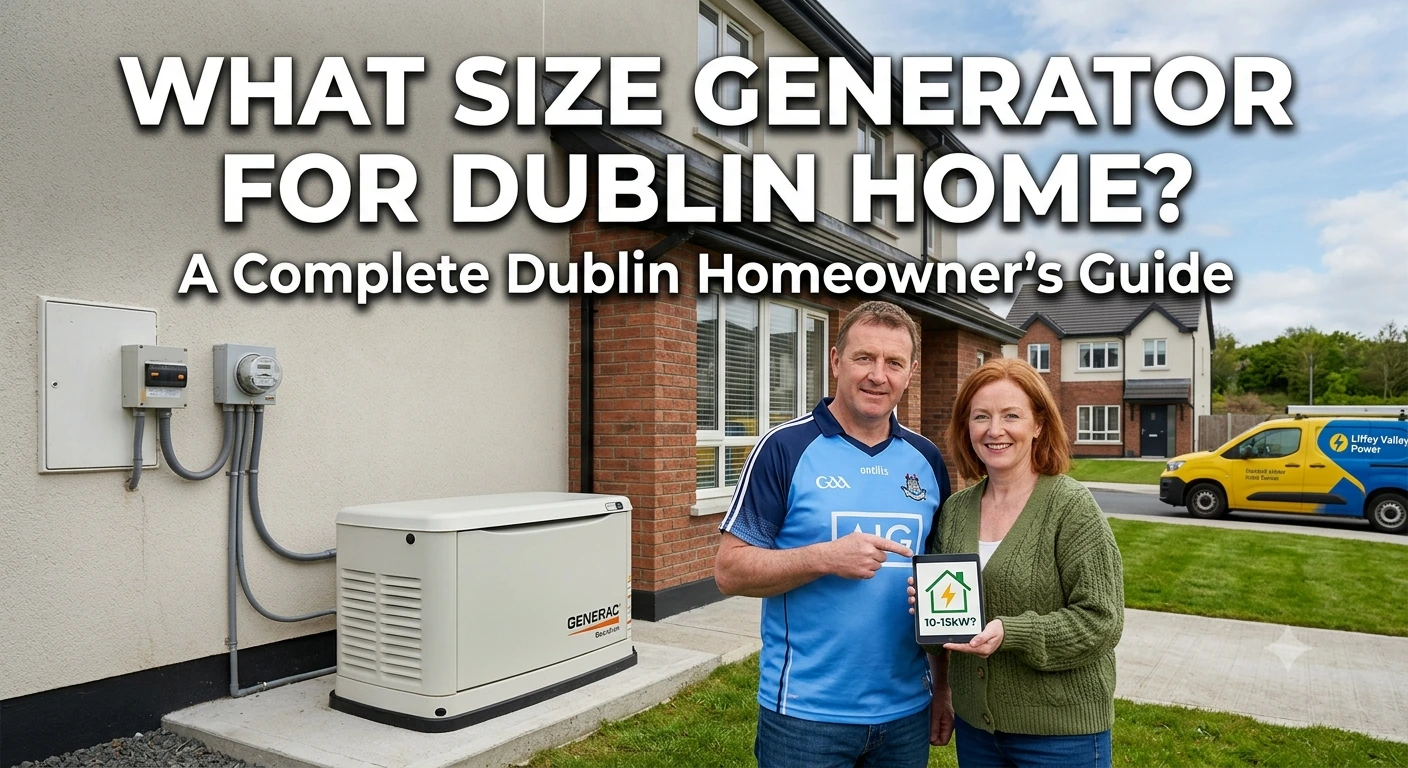
What Size Generator for Dublin Home?
For most 3-bed Dublin homes, an 8kVA to 12kVA diesel standby generator covers your full electrical load, including heating controls, fridge, lighting, and sockets. If you only need critical circuits, a 5kVA to 7kVA unit is sufficient.
The size depends entirely on what you want to power. Get that calculation wrong, and you either waste money on a unit that is too large or burn out a generator that cannot handle your home’s actual demand.
This guide walks you through the exact calculation method we use on every free site survey in Dublin.
kVA vs kW — What Is the Difference and Why Does It Matter in Ireland?
This is the first thing that confuses Dublin homeowners when shopping for a generator. Suppliers list units in kVA. Appliances are rated in watts or kW. They are not the same thing.
kW (kilowatts) is the actual working power your appliances consume. kVA (kilovolt-amperes) is the apparent power the generator produces. The relationship between them is called the power factor.
For most residential generators in Ireland, the power factor is 0.8. This means:
- A 10kVA generator delivers 8kW of usable power (10 multiplied by 0.8).
- A 6kVA generator delivers 4.8kW of usable power.
Always size based on the kW you need, then divide by 0.8 to get the kVA generator required. Every sizing table in this guide uses this calculation.
The Startup Surge Problem — Why Most People Undersize
This is the most common and costly mistake Dublin homeowners make, and it comes up repeatedly in Irish generators. Every appliance with a motor draws significantly more current the moment it starts than it does when running continuously. This is called the startup surge or inrush current.
A fridge compressor that draws 150 watts running can surge to 600 watts or more on startup. A water pump rated at 750 watts running may surge to over 2,000 watts. A heat pump that draws 2kW continuously may pull 5kW or more for the first few seconds.
If your generator cannot supply this surge, it will either cut out, stall, or suffer damage to its alternator windings.
The practical rule for Irish homes: add 25 percent to your total running load calculation to account for startup surges. Then apply the kVA conversion. That is your minimum generator size.
Step by Step: How to Calculate Your Generator Size
Work through these steps before buying anything.
Step 1: List every appliance you want to power during an outage.
Be specific. Do not just write “kitchen.” List the fridge separately from the freezer, the microwave separately from the oven. Each appliance has its own load.
Step 2: Find the wattage of each appliance.
Check the label on the back or base of the appliance, or the original manual. It will show watts (W) or kilowatts (kW). If it shows amps, multiply by 230 (the Irish mains voltage) to get watts.
Step 3: Add all running wattages together.
This is your total running load in watts. Divide by 1,000 to convert to kW.
Step 4: Add 25 percent for startup surge.
Multiply your total kW by 1.25.
Step 5: Convert to kVA.
Divide your surge kW figure by 0.8. The result is the minimum kVA generator you need.
Common Appliance Load Table for Dublin Homes
| Appliance | Typical Running Watts |
| Fridge freezer | 150 to 200W |
| Chest freezer | 100 to 150W |
| Gas boiler controls and pump | 100 to 250W |
| Oil boiler controls and pump | 200 to 400W |
| Heat pump (air to water) | 1,500 to 3,000W |
| Electric shower (10.5kW) | 10,500W |
| Kettle | 2,000 to 3,000W |
| Microwave | 800 to 1,500W |
| Washing machine | 500 to 2,500W |
| Tumble dryer | 2,000 to 5,000W |
| Dishwasher | 1,200 to 2,400W |
| LED lighting (full house) | 200 to 600W |
| Television | 50 to 200W |
| Router and broadband | 15 to 30W |
| EV charger (7.2kW) | 7,200W |
| Induction hob | 3,500 to 7,200W |
| Electric oven | 2,000 to 3,500W |
Note that most Dublin homeowners running a generator during an outage do not run everything simultaneously. The kettle, washing machine, and dishwasher are not all running at once. Your realistic simultaneous load is what matters, not the theoretical total.
Generator Sizing by Dublin Property Type
1-Bed Apartment or Small House — Critical Circuits Only
Target appliances: fridge, lighting, sockets for charging and broadband, gas boiler controls.
- Total running load estimate: 800 to 1,200W
- After surge allowance and kVA conversion: 3kVA to 4kVA
- Recommended generator: 3.5kVA to 5kVA
This is the compact portable generator range. A unit in this range is relatively quiet, easy to move, and costs €400 to €900. It is not suitable for electric showers, heat pumps, or EV charging.
2-Bed House or Apartment — Comfortable Partial Coverage
Target appliances: fridge, freezer, oil boiler controls and pump, lighting, television, broadband, phone charging, microwave.
- Total running load estimate: 2,000 to 3,000W
- After surge allowance and kVA conversion: 5kVA to 6kVA
- Recommended generator: 6kVA to 7kVA
This is the most popular size among Dublin homeowners who experienced Storm Eowyn outages. A 5.2kW to 6kW unit will run everything listed above comfortably.
3-Bed Semi-Detached Dublin Home — Full Practical Coverage
Target appliances: all of the above plus washing machine, oil or gas boiler with pump, electric shower on its own circuit, and possibly a tumble dryer.
- Total running load estimate: 5,000 to 8,000W running, excluding electric shower.
- After surge allowance and kVA conversion: 8kVA to 11kVA
- Recommended generator: 8kVA to 12kVA
This is the most common installation size we carry out in 3-bed semi-detached homes across Tallaght, Blanchardstown, Lucan, Clondalkin, and Dundrum. A 10kVA unit gives you comfortable headroom for simultaneous loads without running the generator at full capacity continuously.
One Dublin homeowner with a 32A 6kW generator asked what they could realistically power at home during outages. The answer from experienced users: fridge, boiler, lights, broadband, and phone charging with ease, but not an electric shower or washing machine at the same time.
4-Bed or Larger Detached Dublin Home — Whole House Coverage
Target appliances: all circuits, including the electric shower, the large kitchen, the home office, multiple televisions, and full lighting.
- Total running load estimate: 8,000 to 14,000W
- After surge allowance and kVA conversion: 12kVA to 18kVA
- Recommended generator: 14kVA to 20kVA
If you have a heat pump, size it up further. A heat pump running at 2.5kW to 3kW continuous draw adds significantly to your base load, and the startup surge must be included in your calculation.
Farm or Property with Water Pump
A submersible water pump or surface pump is one of the highest surge-demand appliances in any Irish property. A 0.75kW pump can surge to 3kW on startup. A 1.5kW pump may surge above 5kW.
Dublin outer county properties and farms in Wicklow, Meath, and Kildare borders frequently contact us after portable generators have stalled or tripped when the pump starts. Always size the generator specifically around the pump if you have one.
Recommended generator: 10kVA to 20kVA, depending on pump size and other loads.
What Happens If You Undersize
A generator running consistently above 80 percent of its rated capacity will overheat over time. Running it at full capacity or beyond that to meet startup surges causes voltage instability, which can damage sensitive electronics, including smart home systems, inverters, and modern boilers with electronic controls.
The 80 percent rule for generators means your running load should not exceed 80 percent of the generator’s rated output. A 10kVA generator should not carry more than 8kW of continuous running load.
This is why a 7.5kVA generator is not the right choice for a 3-bed Dublin home that wants full coverage. The maths look close enough on paper, but the surge capacity is not there for simultaneous motor loads.
A homeowner with a 7.5kVA unit confirmed exactly this: the generator ran fine for basic loads but cut out when the washing machine motor started during a cycle.
EV Charger and Heat Pump — Special Sizing Considerations
These are the two additions that change generator sizing most significantly in Dublin homes right now.
A 7.2kW EV charger draws 7,200W continuously. Adding EV charging to your generator load requires a significantly larger unit and a more carefully designed transfer switch arrangement. Most homeowners running a generator during an outage would not charge an EV simultaneously, but if it is a requirement, the generator must be sized accordingly.
A heat pump running at full output in cold Dublin winter conditions draws 2kW to 3kW continuously, with a startup surge that can reach 6kW to 8kW depending on the compressor size. If your home uses a heat pump for heating, size your generator to handle the pump startup surge before anything else.
Petrol vs Diesel Generator — Which Is Right for a Dublin Home
Petrol generators are lighter, cheaper to buy, and readily available in the 3kVA to 7kVA range. They are the right choice for occasional, short-term outage cover. Fuel has a shelf life of around 30 days in the tank before degradation becomes an issue, so it is less suitable for a unit that sits unused for months.
Diesel generators are heavier, more expensive to buy, but significantly more fuel-efficient and better suited to long run times. Diesel in a tank or jerry can stores reliably for 12 months or longer. For a permanently installed standby generator in a Dublin home, diesel is the standard choice.
A noted a Honda petrol generator as a recommendation for suburban Dublin use during short outages. For properties that lost power for 40 hours or more during Storm Eowyn, a diesel standby with an automatic transfer switch is what made the difference.
How We Size Your Generator During a Free Site Survey in Dublin
When we visit your property, we carry out a full load assessment before recommending any generator size or model. This includes:
- Review your consumer unit to identify all circuits and their rated MCBs.
- Discussing which appliances you want to cover during an outage versus which you would switch off.
- Calculating your realistic simultaneous load based on actual usage patterns, not theoretical maximum.
- Assessing the startup surge requirements for your specific boiler, pump, and any motor-driven appliances.
- Recommending the correct generator size, fuel type, and transfer switch configuration for your property and budget.
We then provide a written, fixed-price quote covering generator supply, installation, automatic transfer switch, ESB Networks notification where required, and Safe Electric certification.
This approach means you do not buy a generator that is too small to do the job, or spend significantly more than necessary on capacity you will never use.
Areas We Cover for Generator Installation in Dublin
We carry out generator installations and sizing surveys across all Dublin postcodes, including Tallaght, Clondalkin, Lucan, Blanchardstown, Castleknock, Dundrum, Stillorgan, Foxrock, Dalkey, Dun Laoghaire, Rathfarnham, Terenure, Clontarf, Raheny, Glasnevin, Santry, Swords, Malahide, Portmarnock, and Dublin City Centre. We also cover Wicklow, Meath, and Kildare borders for rural properties and farms.
Frequently Asked Questions
What size generator do I need to power my house in Ireland?
For a standard 3-bed semi-detached Dublin home with an oil or gas boiler, fridge, lighting, and sockets, an 8kVA to 12kVA generator provides comfortable whole-house coverage. For critical circuits only, a 5kVA to 7kVA unit is sufficient. Larger homes or those with heat pumps require 14kVA to 20kVA.
What is the 80 percent rule for generators?
Your continuous running load should not exceed 80 percent of the generator’s rated output. A 10kVA generator should carry no more than 8kW of running load. This protects against overheating and ensures sufficient headroom for startup surges.
Can a 5,000W generator run a house in Ireland?
A 5kW generator can run critical circuits in a 2-bed or small 3-bed home: fridge, boiler controls, lighting, broadband, and phone charging. It cannot run an electric shower, heat pump, or EV charger simultaneously. For full 3-bed coverage, 8kVA to 10kVA is the correct size.
Will a 10kW generator run a 3-bed house in Dublin?
Yes, for most 3-bed Dublin homes, a 10kVA to 12kVA generator will cover all practical loads, including boiler, fridge, washing machine, lighting, broadband, and electric shower used in rotation. It will not cover a heat pump and an electric shower running simultaneously.
Is a 7.5kVA generator enough for a Dublin home?
A 7.5kVA generator delivers around 6kW of usable power. It is sufficient for comfortable partial coverage of a 3-bed home but may struggle with simultaneous high-surge loads such as a washing machine starting while the boiler pump is running. For whole-house coverage with headroom, 10kVA is the safer choice.
What fuel type is best for a standby generator in Dublin?
Diesel is the standard for permanently installed standby generators in Dublin homes. It is more fuel-efficient, stores reliably for 12 months or longer, and suits long run times during extended outages. Petrol is suitable for portable generators used occasionally during short outages.
Ready to Size Your Generator Correctly?
We carry out free site surveys for Dublin homeowners across all postcodes. We calculate your exact load requirements, recommend the right generator size and fuel type, and provide a written fixed-price quote covering everything from supply to Safe Electric certification.
📞 353 8966 00243
Generator Installation Dublin — Full Service Details and Pricing