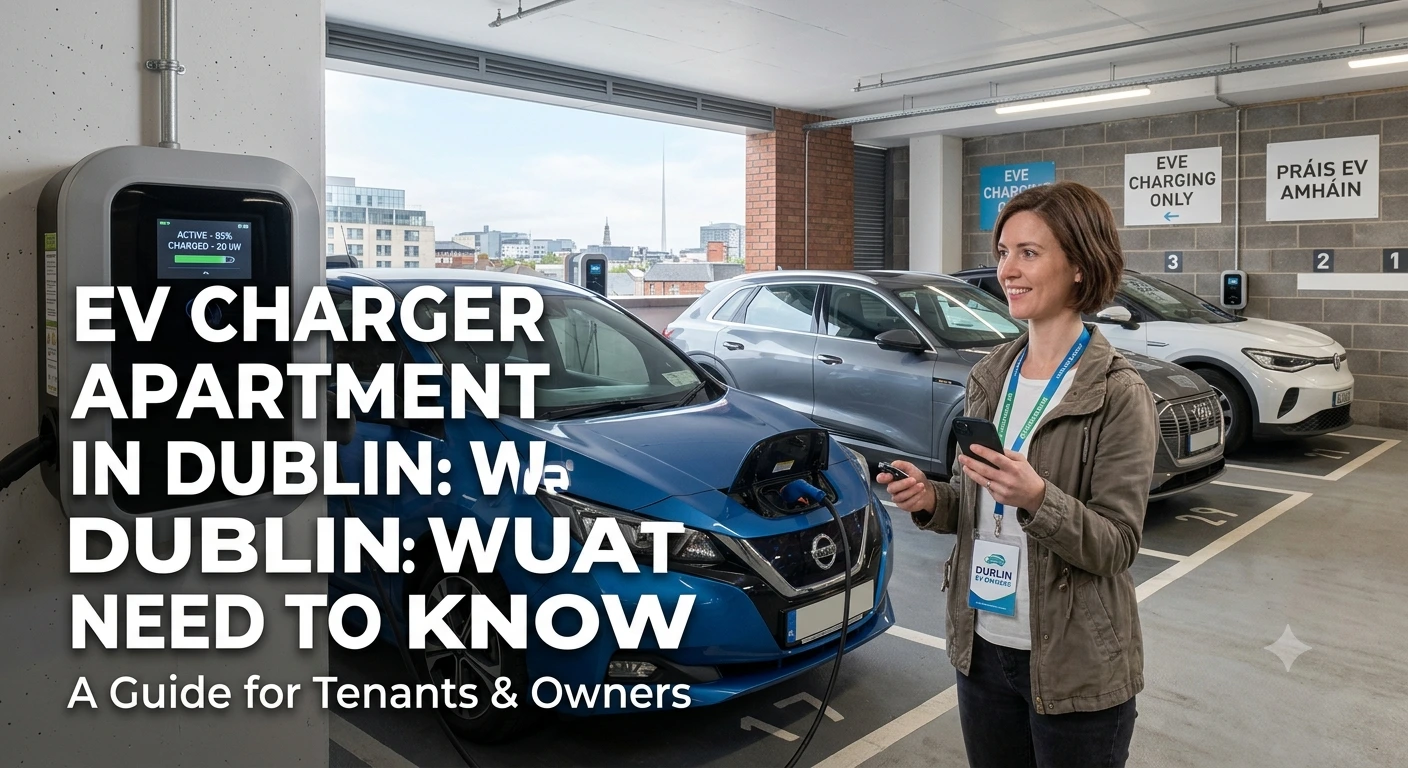
EV Charger Apartment in Dublin: What You Need to Know
Yes, you can get an EV charger apartment in Dublin installed if you own a designated parking space and get written approval from your management company. The SEAI Home Charger Grant of 300 euros applies only if the charger connects to your own electricity supply through your own MPRN, not a shared meter.
This single requirement is the reason so many Dublin apartment owners hit a wall partway through the process. Below is exactly what determines whether your EV charger apartment in Dublin installation qualifies, what the management company approval actually involves, and what the job costs compared to a standard house installation.
Why Apartment Installations Are Different From House Installations
A house installation is usually straightforward. The consumer unit is close to the driveway, cable runs are short, and the homeowner has full authority to approve the work.
An apartment changes almost every part of that equation. Parking may be 30 to 40 metres from your unit’s meter. The parking area may be common property, not part of your title. Multiple owners and a management company are involved in any decision that touches shared infrastructure. And your electricity supply for the charger has to come from somewhere specific for the SEAI grant to apply at all.
Apartment owners report installers telling them they need written permission from the property manager before any survey can proceed, and several describe developments where already installed chargers were later ordered to be removed because the estate’s parking areas and pathways were not approved for that use.
Understanding these requirements before you contact an installer saves weeks of back and forth.
The SEAI Grant Rule That Trips Up Most Apartment Owners
The Home Charger Grant pays a fixed contribution toward a SEAI approved smart charger, but only under specific conditions.
Your charger must connect to your own domestic electricity supply, identified by your MPRN, the meter point reference number on your electricity bill. If your parking space uses a shared meter billed by the management company, or if the charger draws from a communal supply rather than your own unit, the grant does not apply.
This is confirmed directly by SEAI: once the correct charger type and a Safe Electric registered electrician are identified, you can apply for the Home Charger grant, but the connection must trace back to your own MPRN.
A separate SEAI scheme, the Apartment Charging Grant, exists specifically for management companies or owner management companies retrofitting shared charging infrastructure across a whole development. That is a different application route with different funding, aimed at the OMC rather than an individual owner. One Dublin resident noted this exact distinction: the standard home charger grant applies to houses, while apartment blocks have a separate OMC retrofit grant that funds shared infrastructure rather than individual chargers.
If your goal is a private charger for your own space with the standard grant, your own MPRN connection is not optional.
Getting Management Company Approval
This is the step that determines whether the project happens at all, and it is also the step most apartment owners underestimate.
Most Dublin apartment developments have parking areas and pathways classed as common property, managed collectively through an owner management company or a managing agent. Installing anything permanent in that space, including cable runs, wall boxes, and bollards, typically requires written consent before work begins.
The process generally involves submitting a request to the management company or managing agent, providing details of the proposed installation, including charger location, cable route, and installer credentials, and waiting for written approval before any work starts.
Recent ireland describes a case where an installer required written permission from the property manager before proceeding, and the developer later wrote to residents asking that certain chargers be turned off because the installations had not gone through that approval process. Wider coverageireland describes multiple Dublin estates where residents were told to remove chargers already installed at their own expense because pathways and parking spaces used for the cable runs had not been formally approved.
The pattern is consistent: installing without written approval first is the single biggest risk to an apartment EV charger project in Dublin, regardless of how good the electrical work itself is.
Speak to your management company or managing agent before booking a survey. Get any approval in writing, and keep it on file alongside your SEAI application.
The Technical Solution: Cable Run From Your Consumer Unit
Once approval is confirmed, the physical installation usually comes down to one core technical challenge: getting a dedicated circuit from your apartment’s consumer unit to your parking space.
In a typical semi-detached house, this is a short run through an attic or external wall. In an apartment block, your consumer unit might be on the third floor and your parking space in an underground car park 40 metres away. That distance has direct consequences for cable sizing, voltage drop calculations, and total installation cost.
For longer cable runs, the electrician needs to select a larger cable cross section than a standard house job would require, to keep voltage drop within limits and ensure the charger operates safely at full rated output. This routing often has to pass through communal risers, service ducts, or car park ceilings, all of which again require management company sign off since they involve shared building fabric.
An underground parking space roughly 40 metres from the meter or fuse box, which is a realistic distance for many Dublin apartment developments and a good illustration of why apartment jobs typically cost more than house jobs of the same charger specification.
Separate Consumer Unit as an Alternative
Where the existing consumer unit has no spare capacity, or where running a single long cable is impractical, a separate small consumer unit installed nearer the parking space is sometimes the better solution.
This sub panel is fed by its own circuit from the main consumer unit and then supplies the charger locally. It reduces voltage drop over the final stretch of cable to the charger and can simplify future maintenance, since the protective devices for the EV circuit sit close to where the charger is actually used.
This is a design decision made during the survey, based on the distance involved, the condition and capacity of the existing consumer unit, and the practical routing options through the building. It is not needed for every apartment job, but it is common enough in Dublin developments with long cable runs that it should be raised as an option before you commit to a quote.
What Documentation SEAI Requires for Apartment Installations
The paperwork for an EV charger apartment in Dublin grant is the same core process as a house installation, with one extra layer.
You need confirmation that the charger is on the SEAI-approved smart charger list, installation by a Safe Electric registered electrician, and your MPRN linked to the property. Alongside that, for an apartment, you should also retain written management company approval for the installation, since this is frequently requested if any dispute arises later about the legitimacy of cable routing through common areas.
SEAI is explicit that once the correct charger type and a registered installer are identified, you may proceed and apply for the Home Charger grant, but note that some restrictions apply around connection type and property structure, which is exactly where apartment owners need to check their specific case rather than assume a house process applies automatically.
Keep every document together: management company approval, MPRN confirmation, SEAI grant application, and Safe Electric certification on completion. If a dispute over shared area use arises later, as has happened in several Dublin developments, this paperwork is your protection.
Apartment Installation Cost vs a Standard House Job
A standard house EV charger installation with a short cable run typically sits at the lower end of the national pricing range confirmed by Energia, which states that a compliant installation carried out by a registered electrician costs from around 1,000 euro before grant, varying with property specifics.
Apartment installations usually cost more, for three main reasons. Cable runs are longer, often 20 to 40 metres rather than a few metres through an attic. Cable has to be routed through communal risers or car park ceilings, sometimes requiring containment or fire stopping at compartment boundaries. And a separate consumer unit near the parking space, where needed, adds material and labour on top of the base charger installation.
Get a site specific quote after survey rather than assuming a house price applies. The variables that drive apartment costs, cable length, routing complexity, and whether a sub panel is needed, cannot be assessed without seeing the actual parking space and consumer unit location.
Frequently Asked Questions
Can you get an EV charger apartment in Dublin installed?
Yes, provided you have a designated parking space and written approval from your management company. The charger must connect to your own MPRN for the SEAI grant to apply, not a shared meter.
What is the SEAI grant for an EV charger apartment in Dublin?
The standard Home Charger Grant of 300 euro applies if the charger connects to your own domestic supply and MPRN. A separate Apartment Charging Grant funds management companies retrofitting shared charging infrastructure across a whole development, which is a different application route.
Do I need permission from my management company to install an EV charger?
Yes, in almost all Dublin apartment developments. Parking areas and cable routes through communal risers or ceilings are common property, and written approval is typically required before installation, and often requested again if any dispute arises later.
Why does an EV charger apartment in Dublin cost more than a house installation?
Cable runs are usually longer, often 20 to 40 metres compared to a few metres in a house, and may need to pass through communal risers or car park ceilings. A separate consumer unit near the parking space is sometimes needed, adding to material and labour costs.
What happens if I install a charger without management company approval?
Several Dublin developments have required residents to remove chargers installed without prior written approval, even where the electrical work itself was compliant. Get approval in writing before any installation begins.
Get a Site Specific Quote for Your EV Charger Apartment in Dublin
Every apartment development is different, and the right approach depends on your parking space location, consumer unit capacity, and management company requirements. We carry out site surveys across Dublin apartment developments, confirm SEAI grant eligibility for your specific setup, and provide a written quote before any work begins.
Call 353 8966 00243 to arrange a survey.
For full details on our EV charger installation service across Dublin, visit EV Charger Installation Dublin.
For official grant eligibility criteria, see the SEAI Electric Vehicle Charging grant page.