
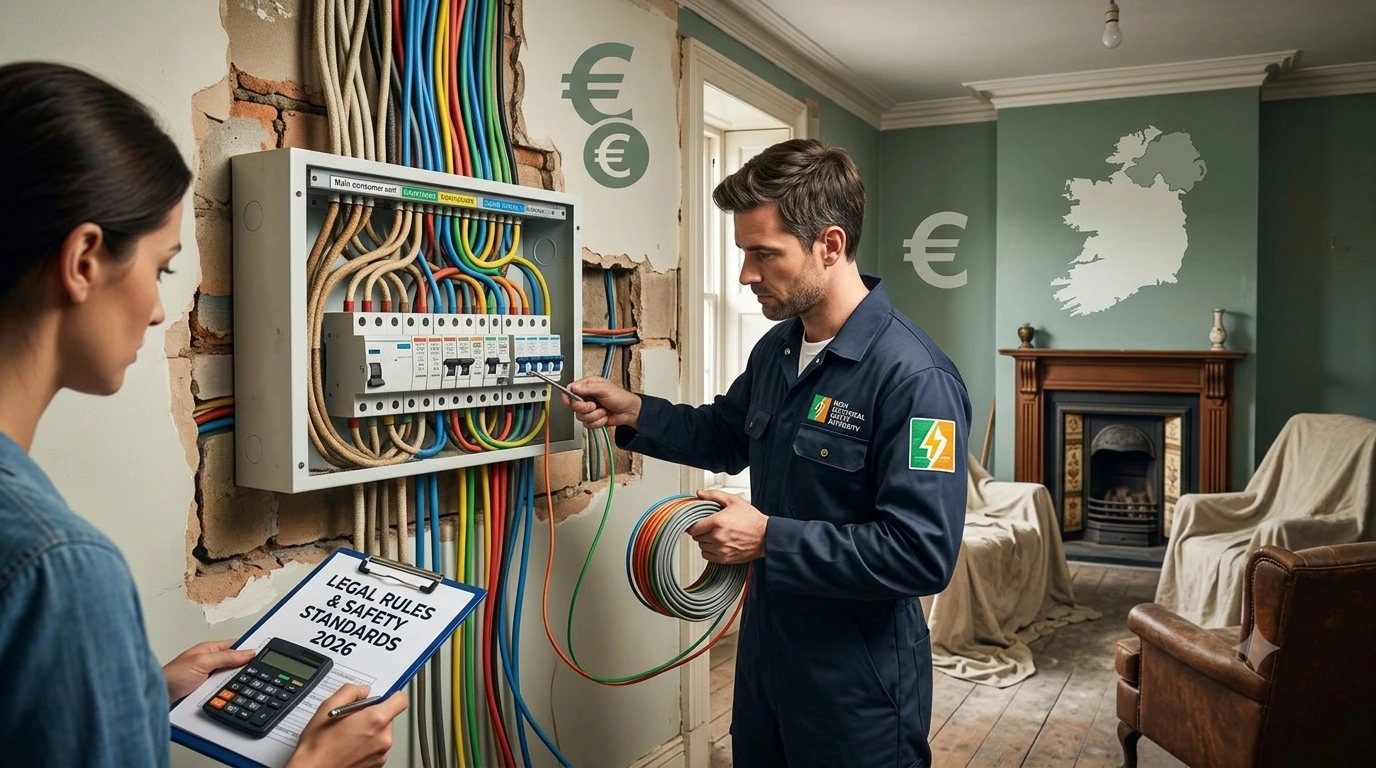
Rewiring a House in Ireland: Legal Rules & Costs 2026
No, you cannot legally rewire your own house in Ireland. House rewiring is notifiable electrical work under the Electricity Regulation Act, and it must be carried out and certified by a Safe Electric registered electrical contractor.
That single rule shapes everything else in this guide, including why DIY rewiring puts your insurance, your mortgage, and your safety at risk, and what you can still do yourself to prepare for the job and keep costs down.
Why House Rewiring Is Not a DIY Job in Ireland
Electrical work in Ireland is regulated through the Electricity Regulation Act 1999 and overseen by the Commission for Regulation of Utilities through the Safe Electric scheme. Certain categories of electrical work are classified as notifiable, meaning they must be carried out by a registered contractor and formally certified once complete.
A full or partial house rewire falls squarely into this category. It involves installing new circuits, connecting a new or upgraded consumer unit, and altering the fixed wiring that supplies your entire home. None of this is something a homeowner can legally do themselves, regardless of experience or confidence with basic electrical tasks.
This differs from countries where homeowners can self certify minor electrical work. In Ireland, rewiring specifically requires a Safe Electric registered contractor from start to finish.
What Notifiable Work Actually Means
Notifiable electrical work is any installation, alteration, or repair to the fixed wiring of a property that could affect safety if done incorrectly. This includes new circuits, consumer unit replacement, rewiring, and the addition of new points such as sockets or lighting circuits tied into the main electrical system.
A Safe Electric registered contractor is required to test every circuit on completion and issue a Completion Certificate. This certificate confirms the work meets the current national wiring rules, and it becomes part of the legal record for that property.
Without this certificate, there is no official proof the rewiring was done safely or correctly, no matter how competent the work actually looks.
What Happens If You Rewire Your Own House
The consequences of DIY rewiring in Ireland go well beyond the risk of a badly wired socket.
No Safe Electric certificate. Only a registered contractor can issue this. Self certification does not exist for rewiring work.
Invalid home insurance. Most Irish insurers require proof of compliant electrical work, particularly after a rewire. If a fire or electrical fault occurs and the insurer discovers the wiring was not certified by a registered contractor, a claim can be refused entirely.
Blocked property sales. Solicitors handling a sale routinely request a Safe Electric Completion Certificate for any recent electrical work. Discussions among Irish homeowners on property forums consistently mention this exact issue coming up during sale-agreed stages, where a lack of certification for previous electrical work becomes a last-minute obstacle.
Real fire and shock risk. This is not a formality. Incorrect circuit protection, poor earthing, or overloaded connections are common causes of house fires. A rewire is one of the few jobs where getting it wrong has genuinely serious consequences, not just inconvenience.
No legal recourse if something goes wrong. If work is not carried out by a registered contractor and a fault later causes damage or injury, there is no professional indemnity or accountability to fall back on.
Homeowners researching this online, particularly on Irish property and personal finance forums, frequently describe being told by an electrician that a mix of old red and black cable alongside newer wiring is present in their home, and being advised that any further work should bring the whole installation up to the current standard rather than patching around it. That advice reflects exactly why partial DIY work, or work by unregistered tradespeople, tends to create bigger problems later.
What You Can Legally Do Yourself
While the electrical work itself is off limits, there is a meaningful amount of preparation you can handle yourself to reduce cost and disruption.
Clearing rooms of furniture before the electrician arrives. Lifting carpets or removing floor coverings in areas where cables need to be run, if you are comfortable doing so. Emptying attic spaces where cable routes will pass through. Removing curtains, blinds, or wall hangings in rooms being worked on. Handling the decorating and painting after the rewiring and plastering work is finished.
Several homeowners on Irish forums mention taking on the making good and redecoration themselves after the electrician completes the technical work, which is a straightforward way to reduce the overall project cost without touching anything electrical.
How to Verify a Safe Electric Registered Contractor
Before any quote is accepted, confirm the contractor is actually registered. This takes a few minutes and protects you completely.
Visit the official Safe Electric website and use the contractor search tool. Enter the company name or registration number that the electrician provides. A genuine registered contractor will have no hesitation sharing this information, and it should match exactly what appears in the official register.
This single check prevents the single most common mistake homeowners make when hiring for a rewire, which is assuming a tradesperson is qualified simply because they seem experienced or came recommended.
Cost of a Professional Rewire vs the Risk of DIY
Full house rewires in Dublin typically range from around 10,000 euros for a smaller three-bed property to 20,000 euros or more for larger four and five-bed homes, with cost driven by the number of rooms, sockets, and circuits involved, along with how accessible the wiring routes are.
Homeowners on Irish property forums regularly report quotes in this range for genuine full rewires carried out by registered contractors, including plastering, a new consumer unit, and certification. Larger or more complex properties, including those requiring significant chasing of walls or working around an occupied household, tend to sit toward the higher end.
Weigh that cost against what DIY or unregistered work actually risks: an insurance claim refused after a fire, a property sale delayed or renegotiated because certification cannot be produced, or, in the worst case, a genuinely dangerous electrical fault in your own home.
The professional cost is significant. The uncertified alternative is not really cheaper once you account for what it puts at risk.
Getting a Proper Rewire Done in Dublin
If your home has a mix of old and modern wiring, frequent electrical issues, or you are simply overdue for an inspection, the right first step is a proper assessment from a registered contractor rather than assuming a full rewire is automatically needed.
We provide house rewiring across Dublin, carried out entirely by Safe Electric registered electricians, with full certification on completion and a clear written quote before any work begins.
Full details on our house rewiring service, typical costs by property size, and what the process involves are available at Rewiring a House Dublin.
You can also verify any electrician’s registration status directly through the Electricity Regulation Act on Wikipedia for background on the legal framework behind Safe Electric registration in Ireland.
Frequently Asked Questions
Can I rewire my own house in Ireland?
No. House rewiring is notifiable electrical work and must be carried out and certified by a Safe Electric registered contractor under the Electricity Regulation Act.
Is there a grant for rewiring a house in Ireland?
Certain supports exist for older or vulnerable homeowners through local authority schemes, but there is no general nationwide rewiring grant available to all homeowners. Eligibility depends on individual circumstances.
How much does a full house rewiring cost in Dublin?
Most full rewires in Dublin fall between 10,000 and 20,000 euro depending on property size, number of rooms and circuits, and site accessibility, based on quotes commonly reported by homeowners across Irish property discussions.
How often should a house be rewired in Ireland?
There is no fixed legal interval, but wiring installed before the 1980s, or showing signs such as mixed old and new cable, frequent tripping, or an outdated fuse board, is generally considered due for assessment and likely replacement.
What happens if I sell my house without a rewire certificate?
Solicitors frequently request a Safe Electric Completion Certificate for any electrical work carried out on a property. Missing certification for a rewire can delay or complicate a sale.




One Comment