
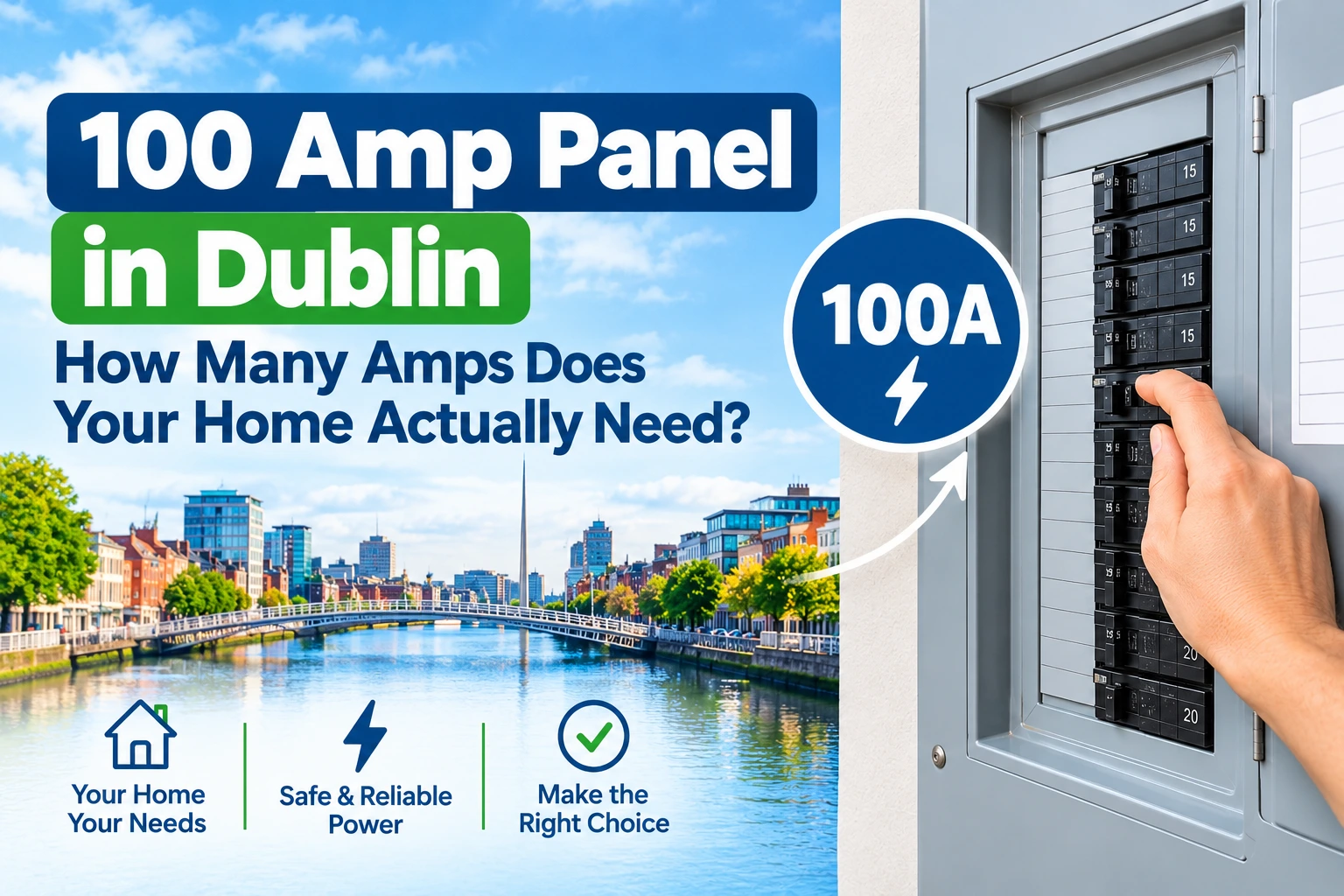
100 Amp Panel in Dublin How Many Amps Does Your Home Actually Need?
Most Dublin homes do not need a 100 amp panel to get more power, because in Ireland the limit is usually your ESB Networks connection, not the panel. A standard Irish home has a 12 kVA single phase supply, which is about 52 amps of maximum demand, so a 100 amp rated board does not add power by itself. This guide explains what a 100 amp panel means in Ireland, how many amps a typical Dublin home needs and when it makes sense to ask for more.
What Does a 100 Amp Panel Mean for a Dublin Home?
The phrase 100 amp panel comes from North America, where homes are supplied at 240 volts and service sizes of 100, 200 or 400 amps are common. A US style 100 amp service delivers roughly 24 kVA, which is about double the 12 kVA of a standard Irish connection. That is why American advice on panel sizes does not transfer to Dublin.
The words change too. A residential electric panel in Ireland is called a consumer unit or fuse board. Electric panelboard is the American term for the same equipment. People who type electronic panel into a search box almost always mean the same electrical panel that protects the circuits in the house.
The Three Amp Numbers in Every Dublin Home
When someone asks about panel amp rating in Dublin, they are usually mixing up three different numbers.
| Number | What it is | Who sets it | Typical Dublin home | Where to find it |
| Supply rating | The size of the connection from ESB Networks, shown as a supply fuse and a maximum import capacity | ESB Networks | 12 kVA with a 63 amp fuse. Some older homes have 8 kVA. Higher options such as 16 kVA with an 80 amp fuse exist | The sealed ESB cut out beside the meter. ESB Networks can confirm your capacity |
| Panel rating | The amp rating printed on the main switch of your consumer unit | Your electrician and the board manufacturer | Often between 63 and 100 amps | The label on the main switch inside the panel |
| Circuit breaker ratings | The amp rating of each breaker protecting one circuit | Your electrician, following IS 10101 | Different for each circuit, such as lighting, sockets, cooker and shower | The number printed on each breaker |
The first number decides how much power you can actually use. The second must suit the first, but raising it does not raise the first. Only ESB Networks can do that. Never open or touch the sealed ESB cut out.
How Many Amps Does a Standard Dublin Home Need?
A standard Dublin home has a 12 kVA connection. Divide 12,000 by 230 volts and you get about 52 amps, which matches the maximum demand ESB Networks quotes for that connection, averaged over 10 minutes. Most homes use only a part of that at any moment.
Appliance loads give you a feel for the numbers. To convert watts to amps, divide by 230.
| Appliance | Typical power | Approximate amps |
| Kettle | 3 kW | 13 |
| Immersion heater | 3 kW | 13 |
| Tumble dryer | 2.5 kW | 11 |
| Induction hob at full power | 7 kW | 30 |
| Home EV charger | 7.4 kW | 32 |
| Electric shower | 9.5 kW | 41 |
Check the rating plate on each appliance, because the figures vary.
Add the shower, the hob and the EV charger and you reach about 100 amps. That is where the idea of needing a 100 amp panel comes from. In real life these loads rarely run together, and a standard connection could not supply them all at once anyway. This is why an electrician carries out a load assessment instead of adding up every appliance.
Is a 100 Amp Panel Enough for My House?
In Ireland, a 100 amp rated panel is more than a standard 12 kVA connection can deliver, so the panel is rarely the weak point. For most Dublin homes the better questions are whether the board has spare ways, whether it has proper RCD protection and whether the supply covers the loads you plan to add.
Spare ways matter as much as the amp number, and our guide to how many ways a typical Dublin home needs explains how to size a board. If your board is old, check the signs that a Dublin electrical panel needs upgrading before you think about amps at all.
A 100 amp panel in Dublin only makes sense when your supply, cables and loads justify it. Fitting a higher rated board on a standard supply gives you a bigger label, not more usable power.
Standard Panel vs 100 Amp Panel: What Actually Changes
| What you compare | Standard board | 100 amp rated board |
| Power you can use | Set by your ESB connection | The same. The board does not raise the supply |
| Main switch rating | A lower rating, such as 63 or 80 amps | 100 amps |
| Room for more circuits | Depends on the number of ways | Often a larger enclosure, but check the number of ways |
| Protection | Depends on the RCD and breaker types | Depends on the RCD and breaker types. The amp rating does not improve it |
| When it helps | Homes where the board matches the supply | Homes that need a higher rated main switch after a supply upgrade |
When Do You Need More Than a Standard Supply?
If you plan to add a home EV charger, a heat pump, an electric shower and an induction hob, your total load can go beyond a 12 kVA connection. ESB Networks guidance asks you to check your total against your maximum import capacity when you add 3 kW or more of new load, such as an EV charger or a heat pump.
A sensible order of steps looks like this:
- List the big loads you have now and the ones you plan to add.
- Ask a registered electrician for a load assessment of the whole installation.
- If the total is above your connection, apply to ESB Networks to increase your maximum import capacity. Higher options such as 16 kVA exist with conditions, and larger needs may call for a three phase supply.
- Once the supply is confirmed, have the consumer unit, main switch and cables sized to suit it.
Some EV chargers can also reduce their output automatically when the house is busy, which can avoid a supply upgrade. We check your supply and board capacity during every survey when you are adding a home EV charger.
How to Check Your Panel Amp Rating in Dublin
You can gather useful facts without touching anything live:
- Look at the label on the main switch of your consumer unit. The amp rating is printed on or beside it.
- Count the breakers and note any free ways.
- Write down your large appliances and their power from the rating plates.
- Ask ESB Networks to confirm your connection capacity. Have your MPRN, the meter number on your bill, ready. Your electrician can also read the cut out.
Do not open the panel or remove any covers. Leave that to a registered electrician.
When to Call an Electrician
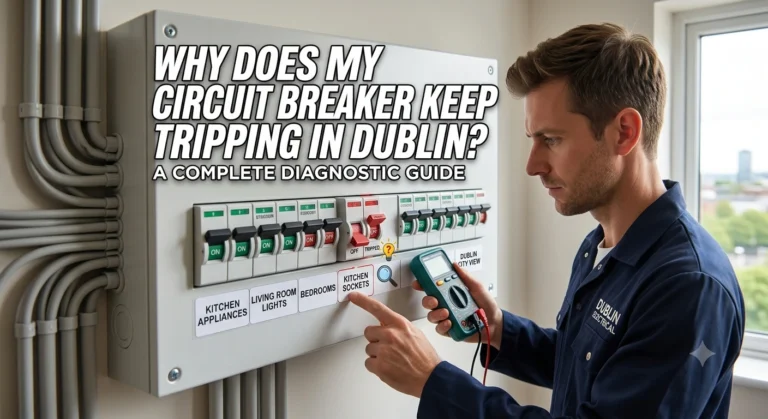
- A breaker trips when two large appliances run together. Our guide on why a breaker keeps tripping in Dublin explains what is normal.
- Lights dim when the shower or oven switches on.
- You plan an EV charger, a heat pump, an extension or a garden office.
- You are not sure what your supply or board is rated for.
A warm panel cover or a burning smell is an emergency, not a capacity question. Switch off the main switch if it is safe to do so and ring for emergency help.
Final Advice
In Ireland the number that matters most is the one on your ESB connection, not the label on the panel. Before you spend money on a bigger board, get a load assessment so that you know what your supply, cables and loads really need.
If you would like a Safe Electric registered electrician to check your supply, your board and your loads, contact us and we will tell you honestly whether a consumer unit upgrade in Dublin is needed.
Frequently Asked Questions
How many amps does a standard Dublin home need?
A standard Dublin home has a 12 kVA ESB Networks connection, which is about 52 amps of maximum demand on a 63 amp supply fuse. Most homes use only part of that at any time. A consumer unit with a main switch that suits the supply is normally enough, and an electrician confirms this with a load assessment.
Is a 100 amp panel enough for my house?
Yes, in most cases. A 100 amp rated panel is more than a standard 12 kVA Irish connection can deliver, so the panel is rarely the limit. What matters is the ESB supply, the number of spare ways and the condition of the board. If you add an EV charger or heat pump, check the supply first.
What is the difference between a 100 amp panel and a standard panel in Ireland?
The difference is the rating of the main switch, not the power you can use. Your ESB connection sets that limit for both. A 100 amp board may also be a larger unit with more ways, but compare the number of ways, the RCD protection and the supply before choosing one.
What is the standard ESB connection for a house in Ireland?
The standard domestic connection is a single phase 12 kVA supply with a 63 amp fuse. Some older homes have an 8 kVA connection. ESB Networks offers higher capacities, such as 16 kVA, under conditions. ESB Networks can confirm the capacity of your own home if you give them your MPRN.
How do I find the amp rating of my electrical panel?
Look at the label on the main switch inside the consumer unit. It shows the amp rating of the panel, and each breaker shows its own rating. Do not remove any covers. The supply rating is separate, so ask ESB Networks or your electrician to confirm it.
Do I need a 100 amp panel for an EV charger in Dublin?
Not necessarily. A home EV charger of 7.4 kW draws about 32 amps, so the key questions are whether your supply has room, your board has a spare way and your cables suit the load. Some homes manage with their existing connection, particularly with a charger that has load management.
Can I get more power from ESB Networks for my home?
Yes. You can apply to ESB Networks to increase your maximum import capacity, for example from 12 kVA to a higher level, and this involves a charge and conditions. An electrician should assess your loads first so that you apply for the right size. A larger panel alone does not increase the supply.
What is an electric panelboard or electronic panel in Ireland?
Both terms usually mean the electrical panel in your home, which Irish electricians call a consumer unit or fuse board. Panelboard is the American word. An electronic panel is not a standard term for it, but people search for it when they mean the board that protects the circuits in the house.
One Comment