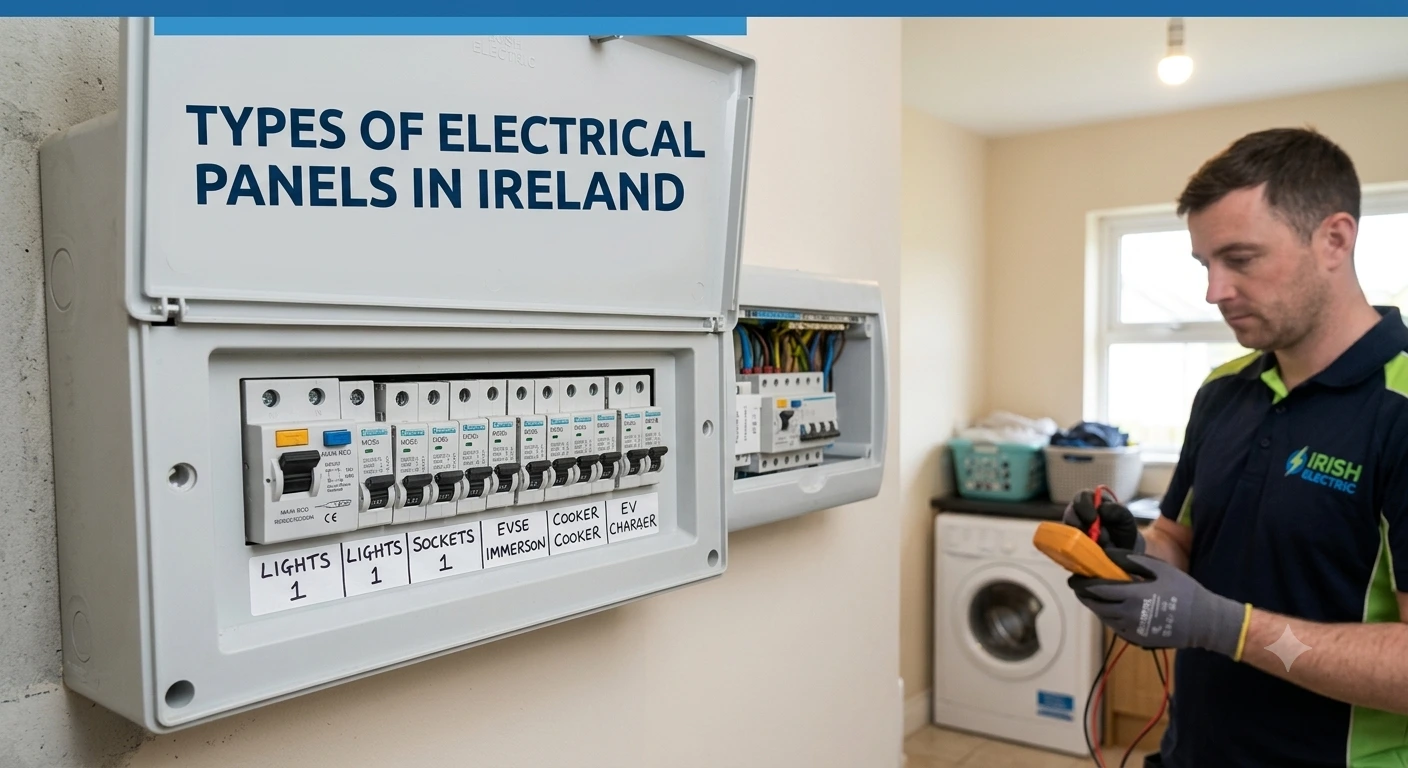
What Types of Electrical Panels in Ireland
Irish homes use a split load consumer unit as the current standard, dividing circuits across two RCDs for both protection and convenience. Older properties may still have a main switch-only board or, in older cases, a rewirable fuse box, both of which fall short of current IS 10101 requirements.
Understanding which type your home has, and which type it actually needs, is the difference between a straightforward electrical job and a costly surprise halfway through an installation. Below is a full breakdown of every panel type found in Irish homes, the ratings and brands involved, and how to know which one is right for your property.
Split Load Consumer Unit: The Current Irish Standard
A split load consumer unit divides your home’s circuits across two separate RCDs rather than protecting everything through a single device. If one RCD trips due to a fault on, say, a kitchen circuit, the other half of the house, including lighting, stays live.
This design became standard practice in Ireland precisely because a single RCD board has a well known drawback: one fault anywhere in the house cuts power to everything, including circuits with no connection to the actual problem. A split load board avoids this by isolating faults to roughly half the property rather than all of it.
Most new installations and full rewires carried out in Dublin today use a split load configuration as a baseline, with high integrity boards used where individual circuit protection matters more, covered further below.
Main Switch Only Boards: The Older Standard
Before split load boards became common, many Irish homes used a simpler board with a single main switch and no RCD protection at all, or RCD protection added later as a separate unit bolted onto an existing board.
If your home still has this type of setup, particularly in properties built before the 1990s, this is one of the clearest signs an upgrade is overdue. Without RCD protection across the circuits, there is no automatic disconnection if a fault develops that could cause electric shock, which is precisely the protection modern boards are designed to provide.
High Integrity Consumer Units
A high integrity board takes the split load principle further by giving certain individual circuits, most commonly a fridge freezer circuit, their own dedicated RCD rather than sharing one with several other circuits.
The reasoning is straightforward. If your fridge freezer shares an RCD with several socket circuits and any one of those trips a fault, the fridge loses power along with everything else on that side of the board, risking spoiled food during what might be a short absence from home. A dedicated RCD for that circuit means a fault elsewhere in the house cannot take the fridge down with it.
This is increasingly specified in new builds and full rewires where homeowners want that extra layer of resilience, particularly for freezers used for medical supplies or for households frequently away from home.
MCB Ratings: Type B vs Type C
Every circuit in a consumer unit is protected by an MCB, and the type matters as much as the amp rating.
Type B MCBs are the standard choice for domestic circuits in Irish homes, covering lighting, socket circuits, and general power use. They are designed to trip at a lower fault current, which suits the relatively gentle startup characteristics of typical household loads.
Type C MCBs are rated for higher inrush currents and are used where equipment draws a significant surge on startup, such as motors, pumps, or certain commercial and workshop equipment. A Type C breaker on an ordinary socket circuit would be the wrong specification, just as a Type B breaker on a circuit feeding a large motor could trip nuisance faults that have nothing to do with an actual problem.
Getting this specification right during installation matters more than most homeowners realise, and it is one of the details a properly registered electrician confirms as part of every consumer unit installation rather than defaulting to a single MCB type across the board.
RCD vs RCBO: Which Circuits Need Which
An RCD protects against earth faults and electric shock risk but does not protect against overload or short circuit current on its own, that is the MCB’s job. Together, an MCB and RCD combination covers both bases.
An RCBO combines both functions in a single device, giving one circuit its own dedicated overload, short circuit, and earth fault protection all in one unit. This is functionally similar to what a high integrity board achieves through separate RCDs, but implemented at the individual circuit level using a single component per circuit rather than splitting the whole board.
RCBOs are commonly specified for circuits where isolating a fault to just that one circuit matters, EV charger circuits, electric shower circuits, and increasingly kitchen circuits in modern installations. The tradeoff is cost, since an RCBO for every circuit costs more than a standard split load arrangement, which is why most homes use a mix, RCBOs on priority circuits and standard split load protection for the rest.
How Many Ways Does a Typical Dublin Home Need
The term way refers to the number of circuit slots available in the consumer unit, and getting this number right avoids a board that is already full the day it is fitted.
A typical two or three bed Dublin home with standard circuits, lighting upstairs and downstairs, sockets upstairs and downstairs, kitchen, immersion, and cooker, usually needs a 10 to 12 way board as a comfortable minimum.
A four bed or larger home, or any property planning ahead for an EV charger, electric shower, or future extension, is generally better served by an 18 way board even if not every slot is used immediately. The cost difference between a 12 way and 18 way board is modest compared to the cost of a second callout later to fit a sub board because the original ran out of space.
This is a detail worth raising directly with whoever quotes your installation. A board sized only for your current circuits, with zero spare capacity, is a common way installations end up needing modification within a few years as households add an EV charger or convert a garage.
Consumer Unit Brands Available in Ireland
Three brands account for the large majority of consumer units fitted in Irish homes.
Hager is widely specified across both domestic and commercial installations in Ireland, known for a broad range covering standard split load boards through to high integrity and three phase options.
Schneider Electric, through its Square D and Schneider branded ranges, is another common choice, particularly in newer builds, with a strong reputation for build quality and a wide accessory range for RCBOs and surge protection devices.
Crabtree remains a familiar name in Irish domestic installations, often specified for straightforward split load boards in standard residential rewires.
All three meet the relevant Irish and European standards when correctly specified and installed, and the choice between them typically comes down to your electrician’s preference, stock availability, and any specific features your installation needs rather than one brand being definitively superior for a domestic Dublin property.
How to Tell What Type of Panel You Have
Open the cover of your consumer unit, without touching anything inside, and look at the switches. A single large switch on its own with smaller switches below and no visible test buttons usually indicates an older main switch only board. Two labelled RCD switches, each with a test button, with MCBs arranged beneath each one, indicates a split load board. Individual switches that each have their own test button rather than sharing one RCD indicate an RCBO based or high integrity setup.
If your board still uses rewirable fuse carriers, ceramic holders with a fuse wire rather than a switch, this predates current MCB based boards entirely and is generally the clearest sign an upgrade is overdue regardless of the property’s age otherwise.
If you are unsure what you are looking at, this is exactly the kind of assessment worth getting confirmed by a registered electrician rather than guessing, particularly before any renovation, extension, or EV charger installation that depends on knowing your existing board’s type and spare capacity.
Frequently Asked Questions
What are the four types of electrical panels?
The main types found in Irish homes are main switch only boards, split load consumer units, high integrity consumer units, and RCBO based boards, each offering a different level of fault isolation and circuit protection.
What are the different types of electrical panels used in Ireland?
Split load consumer units are the current standard, dividing circuits across two RCDs. High integrity boards add dedicated protection for priority circuits like a fridge freezer. Older properties may still have main switch only boards with limited or no RCD protection.
How do I tell what type of electrical panel I have?
Check inside the consumer unit cover for the switch layout. Two RCD switches with MCBs beneath each indicates a split load board. Individual switches with their own test buttons indicate RCBO protection. A single main switch with no RCD test buttons indicates an older board likely due an upgrade.
What is a split load consumer unit and why is it standard in Ireland?
A split load consumer unit divides circuits across two RCDs so that a fault on one half of the house does not cut power to the other half. This is now the baseline standard for new installations and full rewires across Ireland.
Get Your Consumer Unit Assessed in Dublin
If you are unsure which type of panel your home currently has, or whether it has enough spare capacity for an EV charger, extension, or general upgrade, we assess consumer units across Dublin as part of every installation survey.
Call 353 8966 00243 to arrange an assessment.
For full details on installation options, pricing, and what is included in every job, see Electrical Panel Installation Dublin. If you want to understand the warning signs that your current panel may need replacing first, read our guide on Electrical Panel in a Dublin Home.
For background on distribution board standards, see Distribution Board on Wikipedia.
Find us on Google Maps: emergencyelectrician-dublin.ie location