When Should You Upgrade Your Electrical Panel in a Dublin Home?
Your electrical panel, called a consumer unit or fuse board in Ireland, is the heart of your home’s electrical system. Most Dublin homeowners never think about it until something goes wrong. But by that point, the consequences can be serious: an electrical fire, a failed insurance claim, or a blocked property sale.
This guide covers exactly when an upgrade is needed, the warning signs to watch for, and what the process looks like for homes across Dublin, from Tallaght to Clontarf, Blanchardstown to Dun Laoghaire.
What Is an Electrical Panel Called in Ireland?
In Ireland, electrical panel, consumer unit, and fuse board all refer to the same piece of equipment — the central board that receives electricity from ESB Networks and distributes it to every circuit in your home.
If you have searched electrical panel in a Dublin home near me or a fuse board upgrade in Dublin, you are looking for the same thing. The terminology varies, but the equipment and the problem are the same.
7 Signs You Need to Upgrade Your Electrical Panel in a Dublin Home
These are the real warning signs. Not theoretical, these come up repeatedly in conversations with Dublin homeowners in Tallaght, Lucan, Rathfarnham, Dundrum, and across North and South Dublin.
1. Your Board Still Has Rewirable Ceramic Fuses
Open your fuse board. If you see small ceramic cartridges with wire running through them rather than switches, you can flip you have rewirable fuses. These were standard in Irish homes built before the 1970s. They provide no RCD protection, meaning there is nothing to cut the power if a live wire contacts your body or a fault develops near water. They do not meet the current ETCI IS 10101 Irish Wiring Regulations for new or replacement installations. This is not a case of monitoring it. It is a case of replacing it.
2. No RCD Protection on Your Board
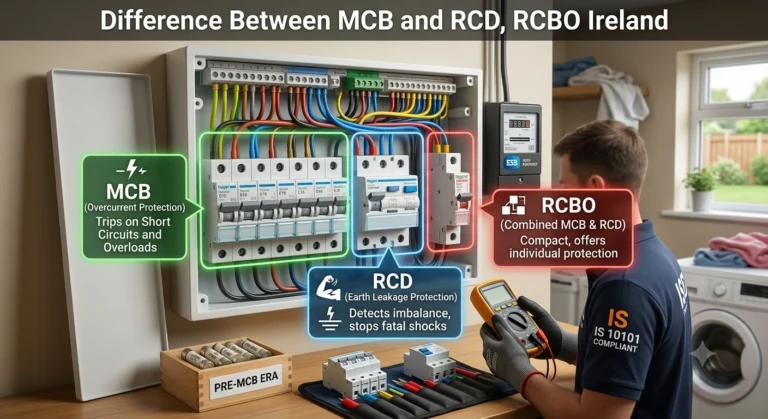
RCDs, Residual Current Devices, are the switches that protect people from electric shock by detecting earth faults and cutting power in milliseconds. Many Dublin homes wired in the 1980s and early 1990s have consumer units without RCD protection, or with only partial protection covering some circuits. You can identify this yourself: look at your consumer unit. If there is no switch labelled RCD or Residual Current Device, your home may lack adequate protection. Under IS 10101, all new and replacement consumer units in Ireland must include RCD protection on socket circuits and bathroom circuits as a minimum.
3. Your Consumer Unit Is Over 25 Years Old
A question that comes up regularly on Irish property forums, including Housing Ireland and Boards, i.e., is whether an older panel needs replacing if it seems fine. The honest answer: components degrade in ways that are not visible. Plastic housings become brittle. Contacts corrode. MCBs lose their calibration and may fail to trip when they should.
The ETCI recommends an Electrical Installation Condition Report (EICR) for any installation over 25 years old. For panels over 40 years old, common in Dublin homes built in the 1960s, 70s, and 80s, a full replacement is almost always the right outcome.
Should a 50-year-old electrical panel be replaced? Yes, without question. A 50-year-old consumer unit in a Dublin home has long exceeded its safe service life.
4. Circuit Breakers Trip Regularly Under Normal Use
A circuit breaker tripping once after you overload a circuit is normal. It is doing its job. A circuit breaker that trips repeatedly when you run the kettle and toaster together, when you switch on the washing machine, and when you use the microwave is telling you something different. Your panel cannot handle the electrical load your home is placing on it. This comes up consistently in Dublin-area housing discussions. Homes built in the 1970s and 80s were designed for a fraction of the electrical load a modern family creates. The panel was never intended to support EV chargers, induction hobs, smart home systems, and multiple large appliances running simultaneously.
5. Burning Smell, Crackling Sound, or a Warm Panel Cover
These are not warning signs. These are emergency signs.
A burning smell near your consumer unit, a crackling or buzzing sound from inside the board, or a panel cover that feels warm to the touch any of these indicates active arcing or overheating inside the unit.
Switch off your main switch immediately if it is safe to do so. Do not switch it back on.
Call us directly on 353 8966 00243. Our emergency line covers all Dublin postcodes 24 hours a day. This is the situation where waiting until morning is not an option.
Emergency Electrician Dublin — 24/7 Response
6. You Are Installing an EV Charger, Heat Pump, or Electric Shower
This is where most Dublin homeowners in 2025 and 2026 are discovering their consumer unit is no longer adequate.
A 7.2kW home EV charger draws 32 amps continuously. A modern heat pump on a cold Dublin night can draw 15–20 amps. A 10.5kW electric shower draws 45 amps on its own circuit.
If your consumer unit is a 1990s split-load board already running close to capacity with circuits for the kitchen, heating, upstairs sockets, lighting, and immersion already allocated, there is often no room for the new dedicated 32A circuit an EV charger requires.
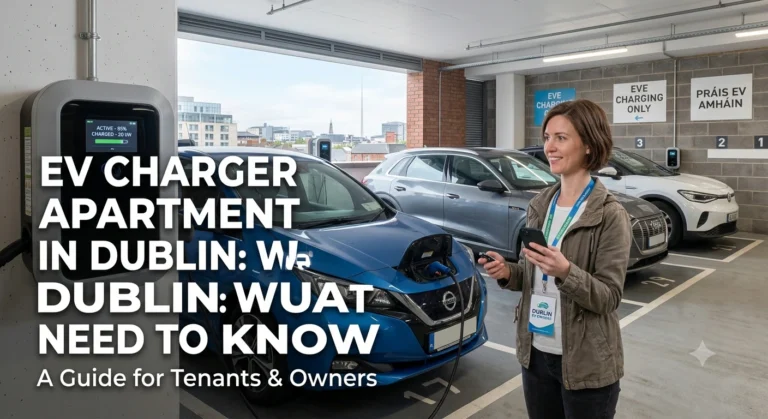
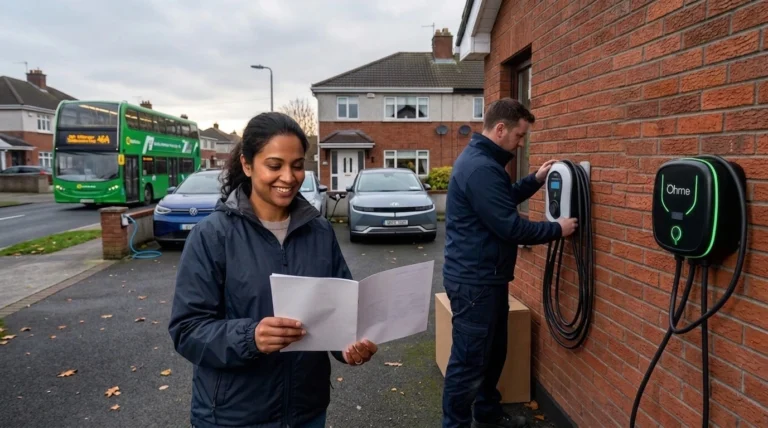
We assess your consumer unit as part of every free EV charger survey. In many Dublin homes, particularly in Clondalkin, Lucan, Blanchardstown, and Tallaght, where the housing stock is predominantly 1980s and 90s semi-detached, a consumer unit upgrade is needed before the charger can be safely installed.
EV Charger Installation Dublin SEAI Grant Available
7. You Are Selling Your Home or Remortgaging
This catches a lot of Dublin homeowners off guard.
Irish solicitors handling conveyances on older properties increasingly require a Safe Electric Completion Certificate or a satisfactory EICR before a sale can proceed. Mortgage providers, particularly for properties built before 1990, are also requesting electrical certification as part of due diligence.
An outdated consumer unit with rewirable fuses or no RCD protection will almost certainly produce an Unsatisfactory EICR result, requiring remedial work before the sale can proceed. Getting ahead of this before you are sale agreed and under time pressure saves significant stress and cost.
What Happens If You Delay?
Three real consequences that Dublin homeowners face when they put off an upgrade:
Electrical Fire Risk. Arcing from corroded connections inside an old consumer unit is a leading cause of domestic electrical fires in Ireland. ESB Networks consistently advises homeowners in older properties to have their electrical installations inspected. An outdated board is not just inconvenient; it is a fire risk.
Home Insurance Problems. Irish insurers are increasingly asking about the age and condition of the consumer unit at renewal. If a fire occurs and your board is found to be non-compliant or uncertified, a claim can be challenged. A Safe Electric Completion Certificate after the upgrade protects your insurance position.
Blocked Property Sale. As noted above, solicitors and mortgage providers are tightening requirements for older Dublin properties. Discovering your consumer unit is a problem during a sale when you are working to a deadline, is a significantly worse position than addressing it proactively.
Upgrading vs Replacing: What Is the Difference?
These terms are sometimes used interchangeably, but they mean different things.
Upgrading typically means adding capacity or improving protection within the existing board, adding an RCBO for a new circuit, for example, or adding a surge protection device. This is appropriate when the board itself is in good condition but lacks a specific feature.
Replacing means removing the old consumer unit entirely and installing a new one. This is the correct approach when the board is over 25 years old, uses rewirable fuses, has no or inadequate RCD protection, or is simply at full circuit capacity.
A related question that comes up: can you upgrade your electrical panel without rewiring your house?
Often, yes. A consumer unit replacement does not automatically require a full house rewire. However, if the wiring inspection carried out during the unit replacement reveals deteriorated cable insulation common in pre-1980s Dublin homes, remedial wiring works will be recommended alongside the panel replacement.
Rewiring a House Dublin Costs, Grants & Timeline
How Much Does a Consumer Unit Upgrade Cost in Dublin?
For Dublin homeowners searching for an electrical panel in a Dublin home, here are the typical ranges:
| Service | Typical Dublin Cost (incl. VAT) |
|---|---|
| Standard Consumer Unit Replacement (1–2 bed) | €600 – €900 |
| Consumer Unit Replacement (3–4 bed) | €800 – €1,200 |
| New Circuit Addition (e.g., for EV charger) | €150 – €350 additional |
| EICR Inspection (before deciding) | €150 – €300 |
These prices include the consumer unit, all MCBs and RCDs, labour, full circuit testing, and your Safe Electric Completion Certificate. For a full breakdown, including what affects pricing and what is included:
Electrical Panel Installation Dublin Full Pricing Guide
Irish Regulations: What Every Dublin Homeowner Should Know
Three things that matter here:
IS 10101, the Irish National Rules for Electrical Installations, governs all consumer unit replacements in Ireland. It specifies the correct MCB types, RCD placement, earthing requirements, and surge protection standards for new installations.
Safe Electric Ireland’s regulatory scheme for electrical contractors. Consumer unit replacement is notifiable electrical work in Ireland. It must be carried out by a Safe Electric Registered Electrical Contractor. You can verify any contractor at safeelectric.ie.
Safe Electric Completion Certificate issued on completion of every qualifying job. This is the document your insurer, mortgage provider, and solicitor will ask for. Without it, the work, however well done, is technically uncertified.
Can I do my own electrical panel work in Ireland? No. Consumer unit replacement is notifiable electrical work. DIY panel replacement is illegal in Ireland, cannot be certified, and invalidates home insurance in the event of a claim.
Areas We Cover in Dublin
We carry out consumer unit assessments, upgrades, and replacements across all of Dublin, including:
South Dublin: Dundrum, Rathfarnham, Tallaght, Clondalkin, Templeogue, Terenure, Stillorgan, Foxrock, Dún Laoghaire, Dalkey.
North Dublin: Clontarf, Raheny, Santry, Finglas, Glasnevin, Swords, Malahide, Portmarnock.
West Dublin: Lucan, Blanchardstown, Castleknock, Clonsilla, Dublin 15
Same-day and next-day assessment appointments are available across all areas. Emergency response 24/7.
Frequently Asked Questions
How do I know if my electrical panel needs upgrading in Dublin?
The clearest indicators are: rewirable ceramic fuses in the board, no RCD switches visible, a panel over 25 years old, frequent circuit breaker tripping under normal use, and any burning smell or warmth near the board. An EICR (Electrical Installation Condition Report) will give you a definitive answer. We carry these out as part of a free on-site assessment.
What is the lifespan of a consumer unit in Ireland?
A quality consumer unit has a service life of 25–40 years under normal conditions. However, the electrical demands placed on Irish homes have increased significantly since the 1990s. EV chargers, heat pumps, and smart home systems were not part of the calculation when most of Dublin’s housing stock was built.
Can I upgrade my electrical panel without rewiring my house in Ireland?
Often yes. A consumer unit replacement and a full house rewire are separate works. However, if the wiring inspection during a panel replacement reveals deteriorated cable insulation common in Dublin homes built before 1985, rewiring may be recommended as a follow-on.
Is a 20-year-old wiring safe in an Irish home?
Wiring installed in the early 2000s is approaching the upper end of its expected service life. Whether it is still safe depends on the installation quality, the load it has carried, and its current condition. An EICR is the correct way to assess this, not age alone.
How much does an electrical panel upgrade cost in Dublin?
A standard consumer unit replacement in Dublin costs €600–€1,200, including VAT, all components, labour, testing, and Safe Electric certification. The exact cost depends on your property’s size and the number of circuits.
Does a house electrical panel need to be sealed in Ireland?
Yes, consumer units must be enclosed in appropriate fire-resistant enclosures. Consumer units installed in timber-framed buildings or areas with increased fire risk require metal-clad enclosures under current IS 10101 requirements. Plastic-fronted boards have been phased out for new installations in Ireland.
How often should panels be replaced in Ireland?
The ETCI recommends an EICR inspection every 10 years for owner-occupied homes and every 5 years for rented properties. Replacement is recommended when an inspection returns an unsatisfactory result or when the installation is over 25–30 years old.
Is upgrading an electrical panel worth it in Dublin?
Yes on multiple grounds. Safety: It significantly reduces fire and shock risk. Financial: it protects your insurance position and removes a common obstacle to property sale. Practical: it gives your home the capacity to support EV charging, heat pumps, and smart home technology.
Ready to Get Your Consumer Unit Assessed?
We provide free on-site assessments for Dublin homeowners across all postcodes. We will tell you honestly whether an upgrade is needed, what the scope of work involves, and give you a fixed written quote before anything begins.
Call us now: 353 8966 00243
No call centre. No vague quotes over the phone. A Safe Electric registered electrician visits your property, inspects your consumer unit, and gives you a clear answer.
Electrical Panel Installation Dublin Full Service Details & Pricing