Why Does My Circuit Breaker Keep Tripping in Dublin? A Complete Diagnostic Guide
Your circuit breaker tripped. You reset it. It tripped again.
This is one of the most common calls we get from homeowners across Dublin, from Tallaght to Clontarf, Lucan to Dún Laoghaire. And the frustrating part is that most people have no idea whether it is a minor inconvenience or a warning sign of something genuinely dangerous.
This guide explains exactly what is happening, how to identify the cause, what you can safely do yourself, and when you need a certified electrician on-site fast.
First: Understand What Just Happened
When a circuit breaker — called an MCB (Miniature Circuit Breaker) in Ireland. trips, it has done exactly what it was designed to do. It detected a problem on the circuit and cut the power to prevent damage or injury.
The same is true for an RCD (Residual Current Device) — the larger switch on your consumer unit that protects against earth faults and electric shock. When your RCD trips, it has detected current leaking somewhere it should not be. One trip under unusual circumstances is normal. The same breaker tripping repeatedly — especially under ordinary household use — is your electrical system telling you something is wrong.
MCB Trip vs RCD Trip — How to Tell the Difference
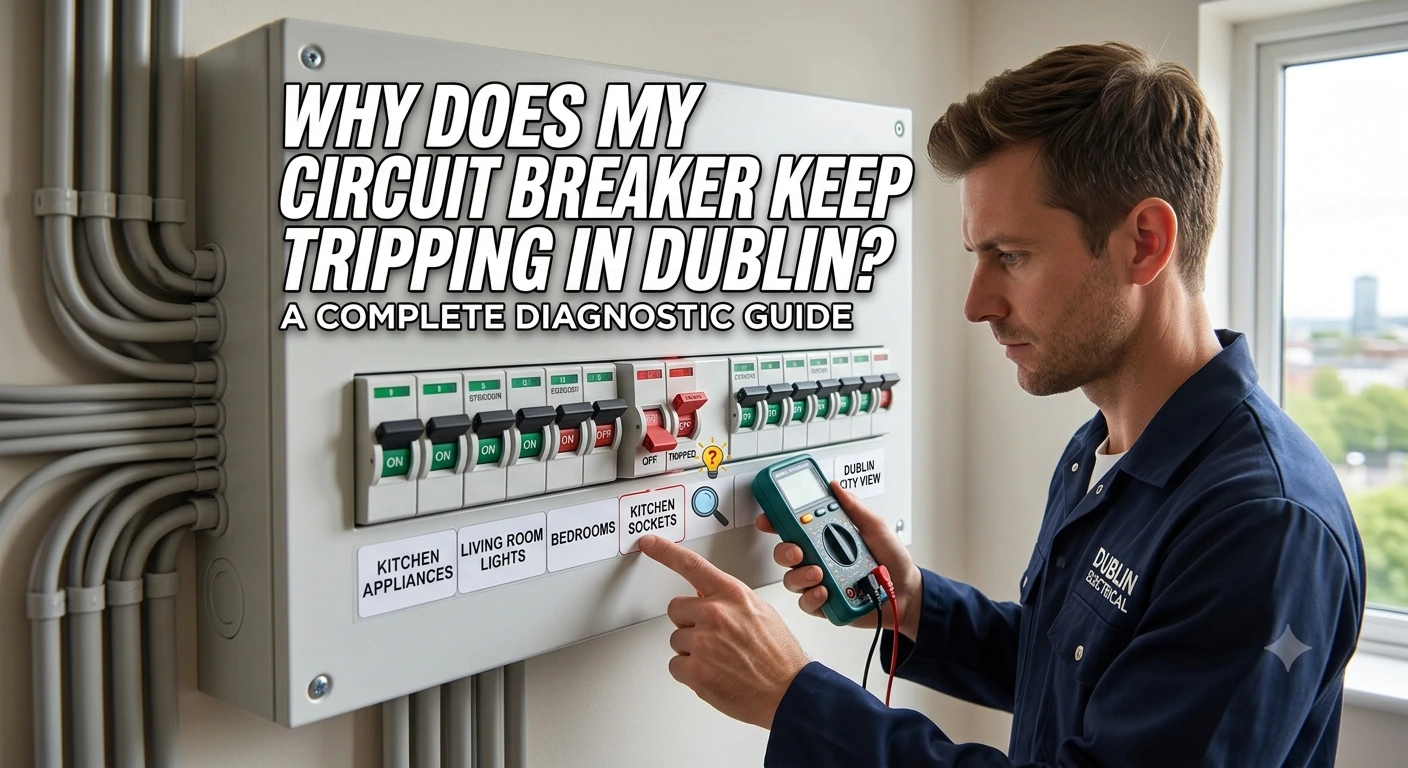
Before diagnosing the cause, you need to identify which device has tripped. Look at your consumer unit (fuse board). If a single narrow switch has flipped to the middle or off position that is an MCB trip. It affects only the circuit that MCB protects: one ring of sockets, the lighting in one area, or a single fixed appliance.
If the larger switch usually labelled RCD or marked with a test button has tripped that is an RCD trip. It cuts power to everything on that half of the board. You will lose multiple circuits at once.This distinction matters because the causes are different and so is the approach to finding the fault.
| MCB Trip | RCD Trip | |
|---|---|---|
| What tripped | Single narrow switch | Larger switch with test button |
| What loses power | One circuit only | Multiple circuits |
| Likely cause | Overload or short circuit | Earth fault or faulty appliance |
| Immediate risk | Lower | Higher — earth faults involve shock risk |
7 Reasons Your Circuit Breaker Keeps Tripping in Dublin
1. Circuit Overload The Most Common Cause
Every MCB has an amperage rating. A standard socket circuit in an Irish home runs on a 20A MCB. A lighting circuit typically runs on a 6A MCB. When the total current drawn from devices on that circuit exceeds the MCB’s rating, it trips.
This happens more often than you might expect in Dublin’s older housing stock. A 1980s semi-detached in Clondalkin or Blanchardstown was wired for the appliances of that era — not for a modern kitchen running an induction hob, a built-in oven, an instant boiling water tap, and a dishwasher simultaneously.
How to identify it: The MCB trips only when multiple high-draw appliances are running at the same time. It resets easily and holds until you overload the circuit again.
What to do: Redistribute the load. Move some appliances to a different circuit. If the circuit is genuinely undersized for your needs, a dedicated circuit with a correctly rated MCB is the right solution.
2. Short Circuit Trips Immediately, Every Time
A short circuit occurs when a live conductor (brown wire) directly contacts a neutral conductor (blue wire), either in a socket, a light fitting, an appliance cable, or behind a wall. The result is a sudden, massive current surge — the MCB trips instantly. Unlike an overload, a short circuit trips the breaker the moment you switch on the circuit or appliance. There is no delay.
On Reddit’s r/DIYUK, a Dublin homeowner described exactly this: breaker suddenly starting to flip turned out to be a faulty power strip that had failed internally. Unplugging appliances one by one identified it within minutes.
How to identify it: Unplug everything on the affected circuit. Reset the MCB. If it holds with nothing plugged in, plug appliances back in one at a time. The one that trips the breaker when plugged in or switched on is the source.
What to do: If a faulty appliance is the cause, stop using it. If the MCB trips even with nothing plugged in, the fault is in the fixed wiring. Call a certified electrician do not keep resetting it.
3. Earth Fault — Why Your RCD Keeps Tripping
An earth fault happens when a live conductor contacts an earthed surface — the metal casing of an appliance, a damp socket, a cable touching a water pipe. The RCD detects the leakage current and trips in milliseconds to prevent electric shock. This is the most important type of trip to take seriously. Earth faults frequently involve water — in kitchens, bathrooms, utility rooms, and outdoor circuits. Damp conditions are a known factor in Dublin homes, particularly in older properties with poor ventilation or undetected water ingress.
Discussions on r/AskIreland regularly show homeowners confused about why unplugging everything still does not allow the RCD to reset. The answer is usually a fault in the fixed wiring itself — not in an appliance — or a failing appliance that is still creating a leakage path even when apparently switched off.
How to identify it: Switch off all MCBs on the affected RCD bank. Reset the RCD. Then switch MCBs back on one at a time. The one that drops the RCD again is the faulty circuit. On that circuit, unplug all appliances and repeat.
What to do: If you identify a faulty appliance, remove it from service. If the RCD still trips with the circuit isolated and nothing plugged in, the fault is in the wiring. This requires professional fault diagnosis — do not leave it.
4. Faulty or Worn-Out MCB
MCBs have a mechanical service life. After repeated trips — or simply after decades of operation — the internal mechanism can degrade. A worn MCB may trip at currents well below its rated threshold, or fail to hold after resetting even when there is no actual fault on the circuit. This comes up in Quora discussions regularly: breakers tripping at random with no identifiable load change. The breaker itself is the problem.
In Dublin homes built in the 1980s and 1990s, original MCBs are now 30–40 years old. They have done their job — but they are approaching the end of their reliable service life.
How to identify it: The MCB trips under loads that have never caused a problem before, or trips with nothing on the circuit, and the fault cannot be traced to any appliance or wiring fault.
What to do: MCB replacement is notifiable electrical work in Ireland under the Safe Electric scheme. A certified electrician replaces the faulty unit with a correctly rated MCB and tests the circuit. Do not attempt to replace an MCB yourself.
5. Faulty Appliance Creating an Intermittent Fault
A failing appliance, one with a deteriorating heating element, damaged internal wiring, or a failing motor, can create intermittent faults. The appliance works fine most of the time, then creates a brief overload or earth leakage that trips the breaker.
This is particularly common with:
- Washing machines (motor failures, element degradation)
- Dishwashers (element and pump faults)
- Electric showers (element scaling and failure in Dublin’s hard water areas)
- Tumble dryers (heating element and motor faults)
- Older fridges and freezers (compressor start surge)
The intermittent nature makes these frustrating to diagnose, the appliance may appear to work normally for days before tripping the breaker again.
How to identify it: Note exactly when the breaker trips. If it always coincides with a specific appliance, even occasionally, that appliance is the first suspect. Have it tested or replaced before assuming the wiring is at fault.
6. Deteriorated or Damaged Wiring
In older Dublin properties, particularly houses built before 1985 — the original wiring is now at or beyond its intended service life. Rubber-insulated cable, common in homes built before the 1970s, degrades into a brittle, cracked state. Even 1980s PVC cable can suffer damage from physical impact, rodent activity, or years of running near heat sources.
Damaged cable insulation can cause both short circuits and earth faults depending on how the insulation has failed. The fault is often intermittent worse in damp weather, worse when specific appliances create heat on the circuit. This is exactly what Quora contributors note: breakers tripping at random without identifiable cause are frequently associated with damaged or deteriorated wiring inside walls.
How to identify it: Tripping is intermittent, worsens in damp conditions, and cannot be traced to a specific appliance. The property is older and wiring has never been replaced. An EICR (Electrical Installation Condition Report) is the definitive test.
What to do: Professional fault diagnosis, and potentially a partial or full rewire depending on findings.
👉 Rewiring a House Dublin — Costs, Grants & What’s Involved
7. Undersized MCB for the Circuit Load
Sometimes the MCB was never correctly rated for the circuit it protects. This happens in older properties where circuits have been extended or modified without proper assessment, or in homes where major appliances have been added to circuits that were not designed for them.
A 16A MCB on a kitchen ring that now serves an induction hob will trip repeatedly — not because anything is faulty, but because the MCB is undersized for the load. Similarly, a 6A lighting circuit MCB tripping regularly may indicate the circuit has too many high-wattage fittings.
How to identify it: The MCB trips consistently under loads that are within normal household use, and no fault can be found in appliances or wiring.
What to do: A certified electrician assesses the circuit load and installs a correctly rated MCB where appropriate, or creates a dedicated circuit for the high-draw appliance.
What NOT to Do When Your Breaker Keeps Tripping
This is where the most dangerous advice circulates on DIY forums — and it is worth being direct.
Do not keep forcing a tripped breaker back on. If it trips immediately on reset, or within a short time of reset, there is an active fault. Repeatedly forcing it back on risks arc flash inside the consumer unit, overheating of wiring, and in the worst case, electrical fire.
Do not ignore a tripping RCD. An RCD trips because it has detected current going somewhere it should not — potentially through a person or through a path that could cause a fire. It is not a nuisance device. It is working correctly.
Do not open sockets or attempt to inspect wiring yourself. Even with the MCB off, live parts may still be accessible. Fault diagnosis on fixed wiring is work for a certified electrician with the correct test equipment.
Do not replace an MCB or RCD yourself in Ireland. Under the Electricity Regulation Act and the Safe Electric scheme, this is notifiable electrical work. It must be carried out by a Safe Electric Registered Electrical Contractor and certified on completion.
The Safe Step-by-Step: What You Can Do Yourself
There are safe, sensible steps you can take before calling an electrician. This approach, described across multiple Irish electrical forums, helps identify the fault without creating additional risk.
Step 1 — Identify what tripped. MCB or RCD? Single circuit or multiple circuits?
Step 2 — Unplug all appliances on the affected circuit. If it is an RCD trip, switch all MCBs on that RCD bank to off first.
Step 3 — Reset the tripped device. If it holds, move to Step 4. If it trips immediately with nothing connected, the fault is in the fixed wiring — stop here and call an electrician.
Step 4 — Switch MCBs on one at a time (for RCD trips) or plug appliances back in one at a time (for MCB trips). When the device trips again, you have identified the faulty circuit or appliance.
Step 5 — For a faulty appliance: Take it out of service and have it repaired or replaced.
Step 6 — For a fault that cannot be isolated to an appliance: Call a certified electrician. Do not continue resetting.
How Much Does It Cost to Fix a Tripping Circuit Breaker in Dublin?
Pricing depends entirely on what is causing the fault:
| Fault Type | Typical Dublin Cost (incl. VAT) |
|---|---|
| Fault diagnosis / call-out (identify cause) | €80 – €150 |
| Single MCB replacement | €80 – €150 |
| Single RCD or RCBO replacement | €120 – €200 |
| New dedicated circuit + MCB | €200 – €400 |
| Consumer unit upgrade (where panel is the issue) | €600 – €1,200 |
| Partial rewire (where wiring is the fault) | From €1,500 |
The most important thing to know: fault diagnosis first, repair second. An electrician who replaces parts without diagnosing the actual fault is guessing. We identify the cause before recommending or quoting any work.
👉 Circuit Breaker Installation Dublin — Full Pricing & Service Details
When It Is an Emergency — Call Immediately
Some situations with tripping breakers require an emergency call rather than a scheduled visit. Call us now on 353 8966 00243 if:
- There is a burning smell from your consumer unit or any socket
- You can hear crackling, buzzing, or popping from the board
- The consumer unit cover or any socket is warm or hot to touch
- You have visible scorch marks on the board or around a socket
- Someone has received an electric shock
- The RCD will not reset at all, cutting power to a large part of your home
These are not situations to wait on. Our emergency line covers all Dublin postcodes, Tallaght, Lucan, Blanchardstown, Clontarf, Dundrum, Stillorgan, Dún Laoghaire, Swords, and all areas in between, 24 hours a day.
👉 Emergency Electrician Dublin — 24/7 Response
Frequently Asked Questions
Why does my circuit breaker keep tripping in Dublin?
The seven most common causes are: circuit overload, short circuit, earth fault, worn MCB, faulty appliance, deteriorated wiring, and an undersized MCB for the circuit load. Identifying which applies requires a systematic isolation process, unplug appliances one by one, reset and observe. If the fault cannot be traced to an appliance, a certified electrician should carry out a formal fault diagnosis.
Should I be worried if a circuit breaker trips?
A single trip under unusual load is normal the MCB did its job. A breaker that trips repeatedly under normal use, trips immediately on reset, or where the RCD keeps dropping indicates a real fault that needs professional investigation. Do not ignore repeated tripping.
What should I do if my circuit breaker keeps tripping?
Unplug all devices on the affected circuit. Reset the breaker. If it holds, plug devices back in one at a time to identify the faulty appliance. If it trips with nothing connected, call a certified electrician, the fault is in the fixed wiring and requires test equipment to locate safely.
What is the 80% rule for breakers?
The 80% rule states that a circuit should not carry more than 80% of its rated capacity on a continuous basis. A 20A MCB should not carry more than 16A continuously. This is why circuits that seem fine under brief loads can trip when the same appliances run for longer periods, sustained current close to the rated limit causes thermal tripping.
Is it normal for a breaker to trip randomly?
No. Truly random tripping where no pattern can be identified often points to a failing MCB, deteriorated wiring insulation, or an intermittently faulty appliance. It should be investigated rather than accepted. Breakers do not trip without cause.
How do I find out what keeps tripping my circuit breaker?
Work systematically: switch everything off on the affected circuit, reset the breaker, then switch things back on one at a time. The item that causes the trip is the fault source. If nothing you do causes the trip but it trips later on its own, there is a wiring fault that requires professional fault-finding equipment.
How much does it cost to fix a tripping circuit breaker in Dublin?
A call-out and fault diagnosis typically costs €80–€150 in Dublin. If a single MCB needs replacing, add €80–€150. If the fault is in the wiring or the full consumer unit needs replacing, costs are higher. We quote in writing before beginning any repair work.
How many times can a breaker trip before it needs replacing?
There is no fixed number. However, MCBs that have been tripped and reset many times over their life particularly older units develop mechanical wear that reduces their reliability. A breaker that trips repeatedly over a short period, or that will not reset cleanly, should be replaced regardless of its age.
Can faulty wiring cause breakers to trip in Dublin homes?
Yes, and it is a common finding in Dublin’s pre-1990s housing stock. Deteriorated rubber-insulated cable, physically damaged PVC cable, and poorly terminated connections can all create fault conditions that cause persistent tripping. An EICR inspection identifies wiring faults across all circuits.
Areas We Cover for Circuit Breaker Faults in Dublin
We respond to circuit breaker faults and tripping issues across all Dublin postcodes, including Tallaght, Clondalkin, Lucan, Blanchardstown, Castleknock, Dublin 15, Dundrum, Stillorgan, Foxrock, Rathfarnham, Terenure, Clontarf, Raheny, Glasnevin, Santry, Swords, Malahide, Dún Laoghaire, Dalkey, and Dublin City Centre.
Same-day appointments available. Emergency response 24/7.
Need an Electrician for a Tripping Breaker in Dublin?
We diagnose the actual cause before recommending any work. No guesswork. No parts replaced unnecessarily. Safe Electric registered, fully insured, and available same-day across all Dublin areas.