
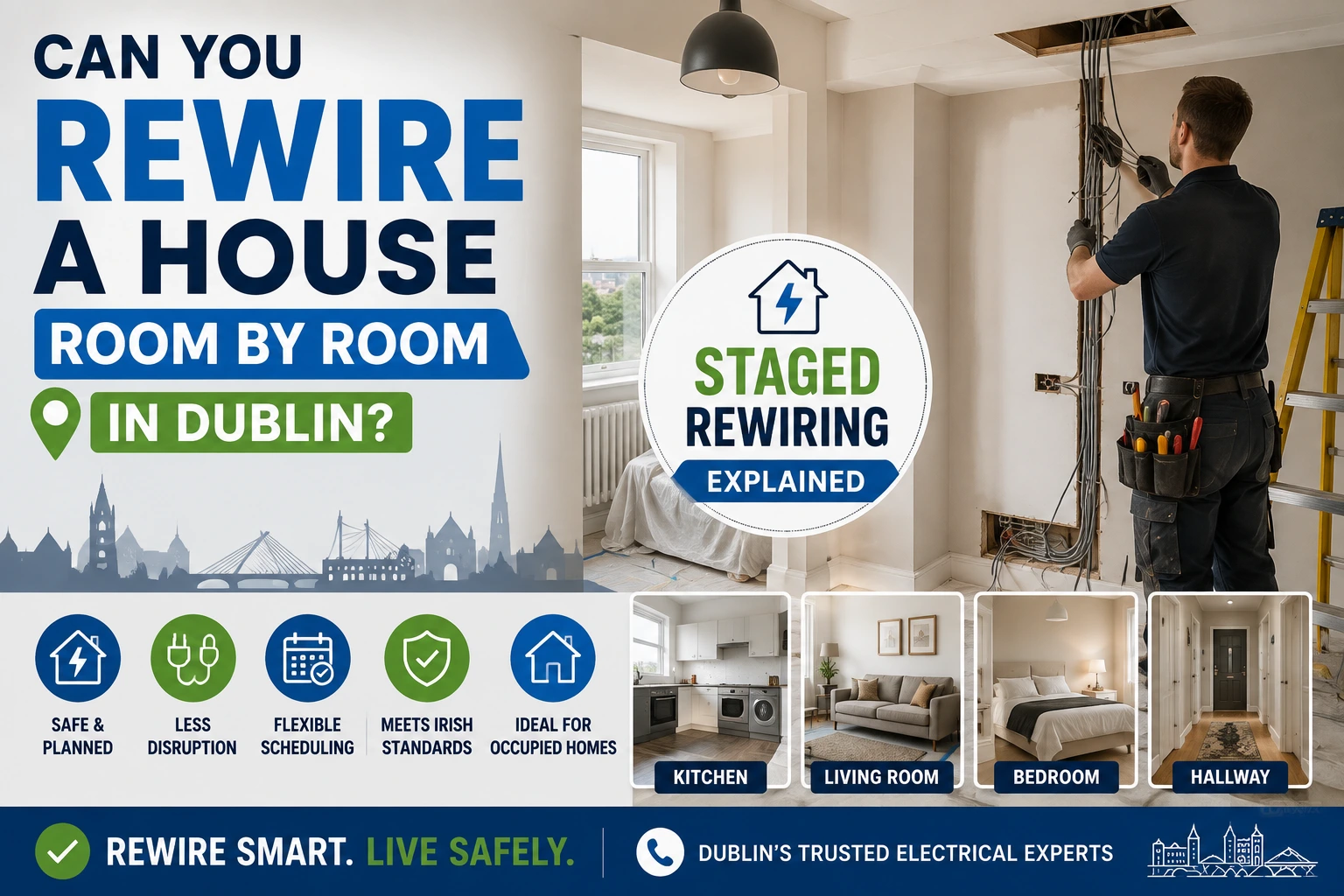
Can You Rewire a House Room by Room in Dublin? Staged Rewiring Explained
Yes, you can rewire a house room by room in Dublin. Staged rewiring lets you spread a full rewire across separate certified phases, prioritising the kitchen and bathroom first for safety, rather than paying the full cost upfront. Below is exactly how staged rewiring works, real Dublin pricing from actual homeowners, and how to plan a multi-year schedule properly.
What Staged Rewiring Actually Means
Staged, or partial, rewiring means splitting a full house rewire into separate phases completed over time, each room or circuit group wired and certified independently, rather than the entire property being done in one continuous job.
This differs from a partial rewire done reactively, where only a faulty circuit gets fixed with no plan for the rest of the house. A properly staged rewire follows a deliberate schedule, with each phase designed to eventually bring the whole property up to current ETCI wiring standards, just spread across a timeline that fits your budget.
How Staged Rewiring Works Technically
Each stage of a house rewiring services in dublin ireland staged plan is treated as its own certified job. The electrician chases and rewires the circuits in that room or zone, connects them into the existing or updated consumer unit, tests that specific work, and issues Safe Electric certification for that completed stage.
This matters practically for one key reason raised repeatedly on Boards.ie’s electrical forum: your fuse board needs room for expansion from the very first stage. If you start with a small consumer unit that has no spare capacity, every subsequent stage becomes more complicated and expensive, since the board itself may need replacing partway through your staged plan rather than at the start. Planning this properly from stage one avoids that trap entirely.
Which Rooms to Prioritise First
Kitchen and bathroom circuits should always come first in any staged plan, for straightforward safety reasons. These rooms combine electricity with water, carry the highest current appliance loads in the home, and are where old wiring faults pose the greatest genuine risk.
After kitchen and bathroom, the next priority is typically the consumer unit itself if it has not already been addressed, since an undersized or outdated board limits what later stages can safely add. Living areas and bedrooms, generally lower risk and lower load, are the sensible final stages in most staged plans.
Real Dublin Rewiring Costs Full vs Room by Room
Actual costs shared by Dublin homeowners on property forums show a wide range depending on house size and scope.
On Boards.ie, one homeowner reported a comprehensive rewire of a three-bed Dublin house costing just shy of €9,000 including VAT. A separate North Dublin thread confirmed nearly identical pricing for the same size property. Askaboutmoney.com discussions from slightly earlier years show a 140 square metre house quoted at €14,000 including VAT for a full rewire with minimal additional sockets.
Reddit’s r/HousingIreland shows the upper end clearly, with one homeowner reporting a quote of €20,000 to €25,000 for a full rewire on a house they were purchasing, and another citing €5,000 just for first fix work alone on a 1,200 square foot four-bed property in a Facebook derelict property restoration group.
For house rewire cost in dublin broken down by property size, Gorman Electrical Services publicly quotes a 2-bed from €11,000 and 3-bed from €12,000 including VAT for 2026, while other Dublin providers like We Rewire Houses quote two-bed properties at €9,000 to €10,000 plus VAT. This spread reflects real market variation, not one fixed price, which is exactly why getting an itemised, room-by-room quote matters.
Is Staged Rewiring More Expensive Overall Than a Full Rewire?
Generally, yes, staged rewiring costs somewhat more in total than completing the entire house in one continuous job, since each stage carries its own separate call-out, setup, and minimum labour charge rather than one consolidated project.
However, this additional total cost is often worth accepting for two practical reasons repeatedly mentioned across Dublin homeowner forums: staged rewiring lets you spread payment across a realistic timeframe rather than needing the full amount upfront, and it allows you to continue living in the property with less disruption at any single point, since only one area is out of action at a time rather than the whole house simultaneously.
One Boards.ie contributor specifically advised that if doing a rewire, doing the whole house in one go is generally preferable where affordable, since staged work “puts most electricians” in an awkward position technically, having to work around live circuits and partially completed systems repeatedly. This is a fair trade-off to weigh, staged rewiring genuinely works, but it asks more of both the homeowner’s patience and the electrician’s planning than a single continuous project.
How Safe Electric Certification Works for Staged Rewires
Each completed stage of a professional house rewire room by room dublin project receives its own Safe Electric Certificate for the specific circuits and work carried out in that phase. This means you build up a complete paper trail across your staged project, rather than waiting years for one final certificate covering everything.
This staged certification is genuinely useful for two reasons. It gives you documented proof of compliant work as each phase completes, useful for insurance and eventual property sale even before the full house is finished. It also means if you sell the property partway through a staged plan, you can honestly show exactly which circuits are certified and current, and which remain on the original wiring, rather than an unclear or undocumented mix.
How to Plan a Realistic Staged Rewire Schedule
Year 1: Consumer unit assessment and upgrade if needed, plus kitchen and bathroom circuits, the highest priority combination for safety.
Year 2: Living areas and hallway circuits, typically the next highest usage zones in the home.
Year 3: Remaining bedrooms and any lower-priority circuits, completing the full property.
This three-year structure is a sensible default, but the right pace depends entirely on your budget and how much disruption you can tolerate at any given time. The key principle, confirmed by the consumer unit capacity point raised on Boards.ie, is planning the full scope from the outset even if you are only paying for and completing one stage at a time, so later stages are not compromised by decisions made in stage one.
Pros and Cons of Staged Rewiring vs Full Rewire
Pros: Spreads cost across a manageable timeframe rather than one large upfront payment. Allows the household to continue living in the property with only one area disrupted at a time. Builds documented Safe Electric certification progressively.
Cons: Generally costs more in total than a single continuous project due to repeated call-out and setup costs per stage. Requires careful upfront planning to avoid consumer unit capacity problems partway through. Takes considerably longer to achieve a fully rewired, fully certified property compared to completing everything in one job.
Frequently Asked Questions
Can you rewire a house room by room in Ireland?
Yes. Staged rewiring is a legitimate approach where each room or zone is wired and Safe Electric certified independently, allowing homeowners to spread cost and disruption across a planned schedule rather than completing everything in one project.
What is the average cost to rewire a house in Ireland?
Real Dublin quotes range from around €9,000 for a straightforward three-bed rewire up to €20,000-plus for larger or more complex properties, with published 2026 pricing from Dublin providers starting around €11,000 for a two-bed and €12,000 for a three-bed including VAT.
Can I get a grant to rewire my house in Ireland?
Certain supports exist for older or vulnerable homeowners through local authority schemes, but there is no general nationwide rewiring grant available to every homeowner. Eligibility depends on individual circumstances and should be checked with your local authority.
How often should a house be rewired in Ireland?
There is no single fixed legal interval, but wiring showing age-related signs, mixed old and new cable, frequent tripping, or an outdated fuse board, is generally considered due for assessment and likely replacement regardless of exact age.
Does a house need rewiring after 25 years?
Not automatically, but 25 years is commonly cited as a point where a proper inspection is worthwhile, since wiring, insulation, and consumer unit technology from that era frequently fall short of current ETCI standards even without visible faults.
Is staged rewiring more expensive overall than doing the whole house at once?
Generally yes, since each stage carries its own separate labour and setup cost. However, staged rewiring remains the practical choice for many Dublin homeowners who cannot pay for a full rewire upfront or who need to keep living in the property throughout.
Plan Your Staged Rewire in Dublin
Whether you want a full house rewire completed in one project or a properly planned staged schedule starting with your kitchen and bathroom, we provide itemised, room-by-room quotes and Safe Electric certification for every stage.
Call 353 8966 00243 for a free assessment and staged rewire plan tailored to your budget.
Full details on rewiring services, pricing by property size, and what a full rewire involves are available at Rewiring a House Dublin.
Find us on Google Maps: emergencyelectrician-dublin.ie location





One Comment