Natural Gas vs Diesel vs LPG Generator: Which Is Right for Your Dublin Property?
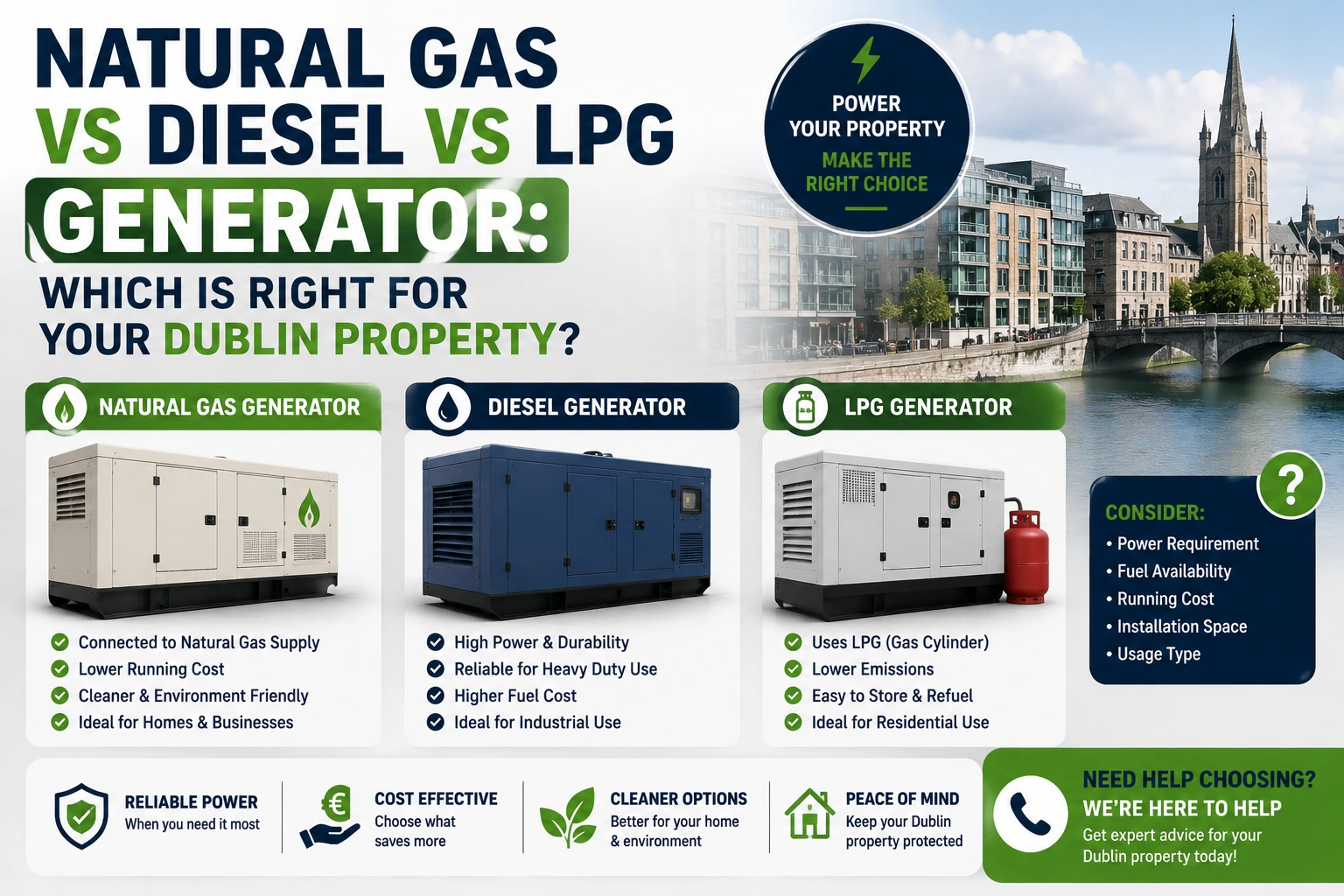
Diesel is the most common choice for whole house standby generators in Dublin, offering the best fuel efficiency and reliable cold weather starting. Natural gas suits properties already connected to the gas network wanting continuous fuel with no storage. LPG works well for smaller suburban installations where diesel storage space is limited.
Each fuel type carries real tradeoffs that matter once you actually own the generator, not just at purchase. Below is a full comparison covering cost, reliability, and which option genuinely fits different types of Dublin properties.
Diesel Generators: The Standard Choice for Dublin Homes
Diesel remains the most widely installed fuel type for standby generators across Dublin and Ireland generally, and for good reason.
Advantages. Diesel offers the best fuel to power ratio of the three options, meaning more energy per litre stored, which translates to longer run times from the same tank size. Diesel is available everywhere in Ireland, unlike natural gas which depends on network coverage. Diesel generators start reliably in cold weather, an important factor during Irish winter outages when temperatures near the tank can drop significantly. Maintenance is generally more straightforward than gaseous fuel alternatives, with fewer specialised parts required.
Disadvantages. Diesel requires on site fuel storage, meaning a tank that takes up space and needs periodic refilling. Stored diesel can develop microbial contamination over time, commonly called diesel bug, particularly relevant in Ireland’s damp climate, and this needs monitoring or fuel treatment to prevent it. Diesel does carry some fire risk during storage, though considerably less than petrol, since diesel does not become explosive under normal conditions even if a tank or line is damaged.
Best suited to larger properties, rural Dublin fringe locations, and any homeowner wanting maximum run time from a fixed fuel supply without depending on a gas connection.
Natural Gas Generators: No Storage, But Network Dependent
Natural gas generators connect directly to the Gas Networks Ireland supply, eliminating the need for any on site fuel storage entirely.
Advantages. With no tank to fill or monitor, a natural gas generator draws fuel continuously from the network for as long as the supply remains connected, which is a genuine advantage during extended outages since you are not managing a finite fuel reserve. Natural gas burns cleaner than diesel, producing fewer emissions and less particulate buildup in the engine over time.
Disadvantages. This option only works where a natural gas connection already exists at the property, which rules it out immediately for many Dublin homes, particularly in areas without gas network coverage. Installation requires connection work carried out by a Registered Gas Installer, adding a step beyond the electrical installation itself. Natural gas generators are also entirely dependent on the gas network remaining operational, which is not guaranteed during a genuinely severe regional event affecting broader infrastructure, though this is a rare scenario compared to electricity outages specifically.
Best suited to Dublin properties already connected to the gas network, where the homeowner wants a set and forget system with no fuel management required.
LPG Generators: The Middle Ground for Smaller Installations
LPG, delivered via bottled propane, sits between diesel and natural gas in terms of practicality for many suburban Dublin properties.
Advantages. LPG burns cleaner than diesel and stores almost indefinitely without the degradation issues diesel can face, since propane does not develop the same microbial contamination problems. LPG generators tend to be more compact, suiting properties with limited space for larger diesel tank installations. For infrequent use, LPG is genuinely convenient, since there is no carburettor cleaning or line flushing required if the generator sits unused for extended periods, unlike petrol.
Disadvantages. LPG has a lower energy density than diesel, meaning a given tank size delivers less run time. This is why most residential installations use it in the 3kVA to 8kVA range rather than for larger whole house systems. Tank refill logistics matter here too, since you are relying on bottled gas delivery rather than a fixed supply, and running out during an extended outage is a real possibility if you have not planned ahead.
Best suited to smaller suburban Dublin homes wanting a 5kVA to 8kVA standby system for critical circuits, without the space or need for a large diesel tank.
Cost Comparison Per kWh in Ireland
Fuel running cost varies meaningfully between the three options, and this is where the decision often comes down to actual numbers rather than preference.
Diesel typically delivers the lowest cost per kWh generated over the medium to long term, largely due to its superior energy density, even though the upfront fuel price per litre may appear higher than other options at times. Natural gas is generally the cheapest fuel per unit of energy where a connection already exists, since there is no storage cost, no delivery logistics, and network gas pricing tends to be more stable than bottled fuel. LPG typically sits at the higher end of running cost per kWh among the three, reflecting both its lower energy density and the delivery and bottling costs built into the retail price.
The practical takeaway for most Dublin homeowners: if you already have a gas connection and want the lowest ongoing cost with zero storage hassle, natural gas wins. If you want the best all round balance of cost, availability, and reliability without depending on network infrastructure, diesel wins. If your priority is compact installation and infrequent use convenience over lowest cost, LPG is the sensible middle ground.
Diesel Storage Regulations in Ireland
If you choose diesel, storage compliance matters and is not optional.
Domestic diesel storage tanks in Ireland fall under EPA guidance and local building regulations, covering bunding requirements to contain leaks, appropriate placement distance from boundaries and buildings, and tank specification standards to prevent environmental contamination. A properly installed generator setup includes a compliant tank specified and positioned correctly from the outset, rather than something retrofitted after the fact. This is one of the details we confirm as part of every diesel generator site survey across Dublin, since getting tank placement wrong at installation stage is far more costly to correct later than to plan properly at the start.
Which Fuel Type Do Most Dublin Properties Actually Choose
Looking at the pattern across Dublin installations, diesel remains the default for larger rural fringe properties and farms where fuel storage space is not a constraint and maximum run time matters most. Suburban semi detached and terraced properties more frequently choose LPG for smaller critical circuit systems, where a compact tank fits realistically into a side return or garden without dominating the space. Natural gas installations are concentrated in areas with existing network coverage, chosen specifically by homeowners who already have a gas boiler connection and want to extend that same reliable supply to their generator.
None of the three is universally correct. The right choice depends on your property’s existing infrastructure, available space, and how you weigh running cost against storage convenience.
Quick Comparison Checklist
Use this to narrow down your decision before booking a site survey.
- Do you already have a natural gas connection at the property → natural gas is worth considering first
- Do you have space for an EPA compliant diesel tank → diesel offers the best overall run time and cost balance
- Is your property suburban with limited outdoor space → LPG suits a compact 5kVA to 8kVA system
- Do you need maximum run time for an extended, multi day outage → diesel typically wins on stored energy density
- Is low maintenance and infrequent use your priority → LPG avoids the fuel degradation issues diesel can face
- Is lowest ongoing running cost your main concern and gas network available → natural gas usually comes out cheapest per kWh
Frequently Asked Questions
Which is more efficient, a diesel generator or a natural gas generator?
Diesel offers better fuel to power efficiency due to higher energy density, meaning more run time from stored fuel. Natural gas is efficient in a different sense, since there is no storage loss and no fuel degradation over time, but it depends entirely on network availability.
Will a 10kW diesel generator run a house in Dublin?
A 10kW diesel generator comfortably covers a standard 3 to 4 bed Dublin home’s essential and near whole house loads, including boiler, fridge, lighting, and most appliances used in rotation rather than simultaneously.
Can an LPG generator run on natural gas?
Some dual fuel generators are designed to run on either LPG or natural gas with the correct regulator and conversion kit, but a generator specified purely for LPG should not be run on natural gas without proper conversion, since the two gases have different pressure and combustion characteristics.
Is it cheaper to run a generator on propane or diesel in Ireland?
Diesel is generally cheaper to run over time due to its higher energy density, meaning fewer litres are needed for the same output. Propane costs more per unit of energy delivered, though it offers longer shelf life and lower maintenance in return.
What is the most common generator fuel type for Dublin homes?
Diesel is the most common choice for larger standby installations, while LPG is frequently chosen for smaller suburban systems where tank space is limited. Natural gas is used specifically where a gas network connection already exists at the property.
Get the Right Fuel Type Recommendation for Your Dublin Property
Choosing between diesel, natural gas, and LPG depends on your property’s specific layout, existing connections, and how much run time you actually need. We assess this properly during every free site survey across Dublin rather than defaulting to one fuel type for every installation.
Call 353 8966 00243 to arrange a survey.
Full details on generator sizing, installation process, and pricing across Dublin are available at Generator Installation Dublin.
Find us on Google Maps: emergencyelectrician-dublin.ie location