
Difference Between MCB and RCD, RCBO Ireland
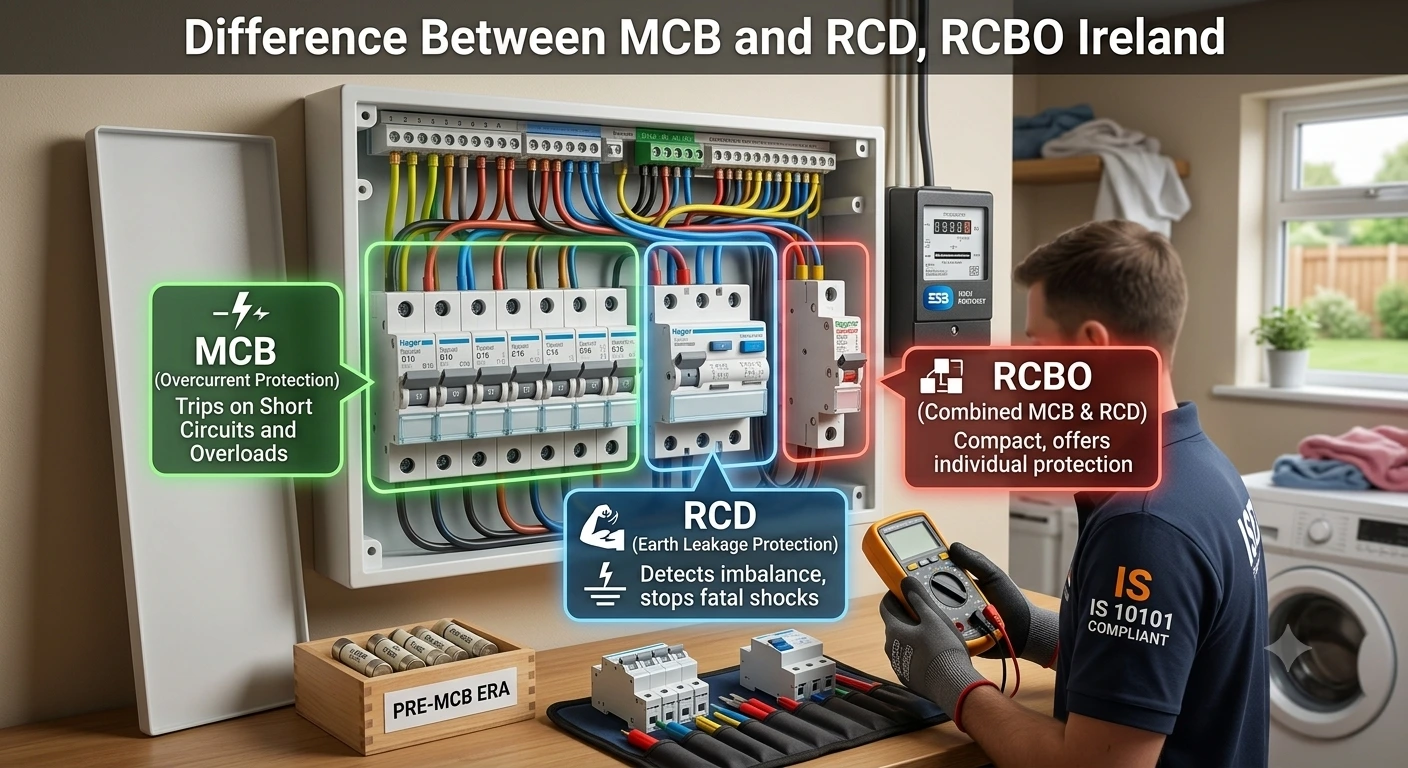
An MCB protects your wiring from overload and short circuits. An RCD protects people from electric shock by detecting current leaking to earth. An RCBO combines both functions into a single device for one circuit.
That single distinction answers most of the confusion homeowners run into when looking inside a consumer unit for the first time. Below is a full breakdown of what each device actually does, when Irish installations use each one, and how to tell them apart just by looking at your own board.
What an MCB Actually Does
MCB stands for miniature circuit breaker. Its job is to protect the wiring and connected equipment on a circuit from two specific faults, overload and short circuit.
An overload happens when too much current flows through a circuit for too long, more than the cable is rated to carry safely, generating heat that could eventually damage insulation or start a fire. A short circuit happens when a live conductor makes direct contact with a neutral conductor, causing a sudden surge of current far beyond normal levels.
An MCB detects either condition and trips, cutting power to that circuit within milliseconds for a short circuit, or after a short delay for a sustained overload. What an MCB does not do is protect people from electric shock. It has no ability to detect current leaking to earth through a person’s body, which is precisely the gap an RCD is designed to close.
What an RCD Actually Does
RCD stands for residual current device. Rather than monitoring for overload or short circuit, it constantly compares the current flowing out through the live conductor against the current returning through the neutral conductor.
Under normal conditions, these two figures should match exactly. If they do not, even by a very small amount, it means some current is escaping the circuit through a path it should not be taking, commonly through a person receiving an electric shock, or through a fault to earth in a damp or damaged appliance. An RCD detects this imbalance and disconnects the circuit within a fraction of a second, fast enough in most cases to prevent a fatal shock.
This is why a circuit protected only by an MCB, with no RCD anywhere upstream, offers no protection against electric shock at all. The MCB simply is not designed to detect that type of fault.
What an RCBO Actually Does
RCBO stands for residual current breaker with overcurrent protection. It combines the overload and short circuit protection of an MCB with the earth leakage detection of an RCD, in a single device dedicated to one circuit.
This solves a specific limitation of a standard split load board, where one RCD typically protects several circuits grouped together. If a fault occurs on any one of those grouped circuits, the shared RCD trips and takes every circuit on that side of the board down with it, even circuits with nothing wrong. An RCBO avoids this entirely, since each protected circuit has its own dedicated device. A fault on one circuit trips only that circuit, leaving everything else on the board unaffected.
The tradeoff is cost. An RCBO for every circuit in a consumer unit costs considerably more than a standard split load arrangement using shared RCDs, which is why RCBOs are typically specified for priority circuits rather than the entire board as standard.
Where Irish Installations Use RCBOs
Certain circuits in Irish homes are increasingly fitted with a dedicated RCBO rather than sharing an RCD, specifically where isolating a fault to just that circuit genuinely matters.
EV charger circuits are a common example. A fault elsewhere in the house should never be able to interrupt EV charging partway through overnight, and a dedicated RCBO ensures that. Electric shower circuits are another, both for the isolation benefit and because current wiring regulations specifically require RCD protection on shower circuits, commonly delivered through an RCBO. Kitchen circuits are increasingly specified with RCBOs in new installations too, since losing power to a fridge freezer because an unrelated socket circuit developed a fault is exactly the kind of nuisance a dedicated device prevents.
For most other circuits, lighting, general sockets, standard appliances, a shared RCD across a split load board remains the normal, fully compliant approach in Irish domestic installations.
Can You Use an RCBO Instead of an MCB and RCD
Yes, and in many modern installations this is exactly what happens for priority circuits. An RCBO is not a separate category of protection alongside MCBs and RCDs, it is functionally an MCB and RCD combined into one unit for a single circuit.
There is no protection benefit lost by using an RCBO instead of a separate MCB and RCD arrangement, since it performs both jobs simultaneously. The only real consideration is cost and whether shared protection across a split load board is acceptable for that particular circuit, or whether individual isolation is worth the extra expense.
How to Tell the Difference by Looking at Your Consumer Unit
Open the cover of your board without touching anything inside and look at the switches themselves.
A narrow switch with a single lever and no separate test button is an MCB. It protects one circuit against overload and short circuit only.
A larger switch, usually positioned centrally with smaller MCBs arranged beneath it, featuring its own test button, is an RCD. It protects every circuit grouped beneath it against earth leakage, in addition to whatever overload protection those individual MCBs already provide.
A switch that looks similar in width to an MCB but has its own individual test button built into it is an RCBO. It is protecting that one circuit against both overload or short circuit and earth leakage, entirely independently of anything else on the board.
If your board has a mix, some circuits under a shared RCD and others with individual RCBOs, that is a completely standard and compliant arrangement, not a sign of anything wrong.
Why an MCB Might Trip But Not the RCD, or the Reverse
These two devices respond to entirely different fault conditions, which explains why one can trip while the other stays completely unaffected.
An MCB trips on overload or short circuit, situations where current draw exceeds what the circuit is rated for, or where live and neutral make direct contact. None of that necessarily involves any current leaking to earth, so the RCD upstream has nothing to detect and stays closed.
An RCD trips on earth leakage, current escaping to earth through a fault or through a person, which can happen at normal, unremarkable current levels well within what the MCB considers acceptable. The MCB sees nothing wrong from its perspective, so it stays closed while the RCD trips independently.
This is genuinely useful diagnostically. If your MCB has tripped but the RCD has not, the fault is almost certainly an overload or a short circuit rather than a shock or earth fault risk. If the RCD has tripped but the individual MCBs all look fine, you are dealing with an earth leakage issue somewhere on that section of the board, which is a different diagnostic path entirely.
If you are dealing with a breaker that trips repeatedly and you are not sure which device is actually responsible or why, our detailed diagnostic guide walks through the most common causes step by step, including how to identify an MCB trip versus an RCD trip in your own home.
Frequently Asked Questions
What is the difference between MCB and RCD in Ireland?
An MCB protects wiring and equipment from overload and short circuit current. An RCD protects people from electric shock by detecting current leaking to earth. Irish consumer units typically use both together, with MCBs for individual circuits grouped under a shared RCD.
Can I use an RCBO instead of an MCB and RCD?
Yes, an RCBO combines both functions in a single device for one circuit, offering the same protection as a separate MCB and RCD arrangement, with the added benefit of isolating faults to just that circuit rather than a shared group.
How do I tell the difference between an RCD and MCB by looking at my board?
A narrow switch with no test button is an MCB. A wider central switch with a test button, protecting several MCBs beneath it, is an RCD. A narrow switch with its own individual test button is an RCBO.
Why would an MCB trip but not the RCD?
An MCB trips on overload or short circuit current, which does not necessarily involve any current leaking to earth. Since the RCD only monitors for earth leakage, it can remain completely unaffected while the MCB trips on an unrelated fault condition.
Are RCBO and MCB the same thing?
No. An MCB only protects against overload and short circuit. An RCBO protects against the same faults plus earth leakage, combining what an MCB and RCD do separately into one device for a single circuit.
Get Your Consumer Unit Checked in Dublin
If you are unsure whether your home has adequate RCD or RCBO protection, or if a breaker in your consumer unit keeps tripping and you want it properly diagnosed rather than guessed at, we assess and upgrade consumer units across Dublin as part of every callout.
Call 353 8966 00243 to arrange an assessment.
If your breaker is tripping repeatedly and you want to understand exactly why before booking a callout, read our full diagnostic guide on circuit breaker keeps tripping Dublin, which walks through the most common causes step by step.
For full details on consumer unit types, ratings, and installation options across Dublin, see Electrical Panel Installation Dublin.
For background on how residual current devices work, see Residual Current Device on Wikipedia.
Find us on Google Maps: emergencyelectrician-dublin.ie location